I Have All The Data But I Don’t Understand

By recognizing the differences and prioritizing insights and root causes, leaders can enhance their understanding of daily operations. Embracing strategies such as gemba walks, collaboration, data analytics, continuous learning, and mentoring relationships empowers leaders to unlock hidden potential and drive transformative change.

In the fast-paced world of manufacturing, production leaders face a constant influx of data. However, simply acquiring data is not enough to drive operational excellence. To make informed decisions and identify root causes, leaders must strive for a deep understanding of daily operations. In this blog post, we will explore the critical differences between data acquisition and true understanding. Additionally, we will provide practical strategies for manufacturing leaders to enhance their comprehension of daily operations.

1. Overwhelming Data: A Barrier to Effective Processing

In today’s manufacturing landscape, we are inundated with more data than we can effectively process. The sheer volume of information can overwhelm leaders, making it challenging to extract meaningful insights. Leaders must recognize that data alone does not equate to understanding. Instead, it serves as a foundation for deeper analysis and interpretation.

2. Grasping the Root Cause: The Key to Operational Constraint

To overcome operational challenges, leaders must fully understand the problems they encounter. Superficial knowledge of symptoms or surface-level analysis is insufficient. True understanding requires delving into the root cause and uncovering the underlying factors that contribute to constraints or inefficiencies. By addressing the root cause, leaders can implement targeted solutions and drive sustainable improvements.

3. Data vs. Understanding: Bridging the Gap

Recognizing the distinction between acquiring data and reaching a comprehensive understanding is crucial. Mere data acquisition involves collecting information without necessarily gaining insights. True understanding, on the other hand, involves analyzing data, recognizing patterns, and contextualizing the information. It is a cognitive process that leads to meaningful comprehension and informed decision-making.

4. Differentiating Data Acquisition from Understanding

To shed light on the disparities between data acquisition and understanding, let’s explore the key differences:

  • Depth of Analysis: Data acquisition involves collecting information at a surface level, while understanding requires diving deeper, analyzing patterns, and uncovering insights.
  • Contextual Understanding: Data acquisition may provide isolated facts, whereas understanding involves comprehending the context, interrelationships, and broader implications.
  • Interpretation and Synthesis: Understanding necessitates interpretation, synthesis, and connecting the dots between data points, enabling leaders to derive comprehensive insights.
  • Application and Problem-Solving: Data acquisition lacks the ability to apply knowledge to practical situations while understanding empowers leaders to address complex problems effectively.
  • Decision-Making: Understanding enables leaders to make informed decisions by considering various factors, weighing consequences, and assessing the long-term impact.

5. Strategies for Improving Operational Understanding

Manufacturing leaders can enhance their understanding of daily operations by implementing the following strategies:

  • Embrace Gemba Walks: Engage in regular visits to the shop floor to observe operations firsthand, ask questions, and gain a deeper understanding of processes and challenges.
  • Foster Cross-Functional Collaboration: Encourage collaboration between different departments and teams to gain a holistic view of operations, leverage diverse perspectives, and foster knowledge sharing.
  • Invest in Data Analytics: Utilize advanced data analytics tools and techniques to analyze large datasets, identify trends, and uncover meaningful insights that can drive informed decision-making.
  • Continuous Learning: Encourage a culture of continuous learning by providing training opportunities, promoting knowledge-sharing sessions, and encouraging personal development.
  • Develop Mentoring Relationships: Establish mentorship programs where experienced leaders can guide and share their insights with emerging leaders, facilitating knowledge transfer and deepening understanding.

Conclusion

In manufacturing leadership, true understanding surpasses mere data acquisition. It drives effective decision-making and operational excellence. By recognizing the differences and prioritizing insights and root causes, leaders can enhance their understanding of daily operations. Embracing strategies such as gemba walks, collaboration, data analytics, continuous learning, and mentoring relationships empowers leaders to unlock hidden potential and drive transformative change. With a deep understanding, manufacturing leaders navigate complexities with confidence, achieving lasting success.
5 Proven Steps for Effectively Solving Problems

Structured problem-solving is a valuable tool for effectively identifying and addressing problems. It allows for a logical and systematic approach that can help to ensure that the best solution is chosen and implemented. However, there are several factors that can prevent people from using this process, and it is important to be aware of these obstacles in order to overcome them and make the most of this problem-solving method.

Structured problem-solving is a systematic process for identifying and resolving problems. It involves defining the problem, generating potential solutions, evaluating those solutions, choosing the best one, and implementing and testing it. However, there are several reasons why people may not use this approach, including a lack of time, a lack of understanding, personal biases, group dynamics, and resistance to change.

The 5 Steps:

  1. Define the problem clearly and accurately
  2. Generate potential solutions
  3. Evaluate the potential solutions
  4. Choose the best solution
  5. Implement and test the solution

Clarification of Each Strategy

  1. Defining the problem clearly and accurately is the first step in effective problem-solving. This involves understanding the root cause of the problem and identifying any underlying issues that may be contributing to it.
  2. Generating potential solutions involves coming up with as many ideas as possible for addressing the problem. This can be done through brainstorming sessions with a team or individually.
  3. Evaluating the potential solutions involves analyzing each solution and considering its pros and cons. This helps to determine which solution is the most viable.
  4. Choosing the best solution involves selecting the solution that is most likely to effectively address the problem and meet the desired outcomes.
  5. Implementing and testing the solution involves putting the chosen solution into action and evaluating its effectiveness. This may involve making adjustments or trying a different solution if the initial one does not produce the desired results.

Resistance to Structured Problem-Solving

There are several reasons why people may not use structured problem-solving:

  1. Lack of time: Sometimes, people may feel that they do not have the time to follow a structured problem-solving process. They may feel pressure to come up with a solution quickly and may skip steps in order to do so.
  2. Lack of understanding: Some people may not understand the value of structured problem-solving or may not know how to use the process effectively.
  3. Personal biases: People may have their own biases or preconceived notions that prevent them from considering all possible solutions or evaluating them objectively.
  4. Group dynamics: In a group setting, there may be social pressures or dynamics at play that prevent people from fully participating in the problem-solving process.
  5. Resistance to change: Some people may be resistant to trying new approaches or may be comfortable with their existing ways of problem-solving, even if they are not the most effective.

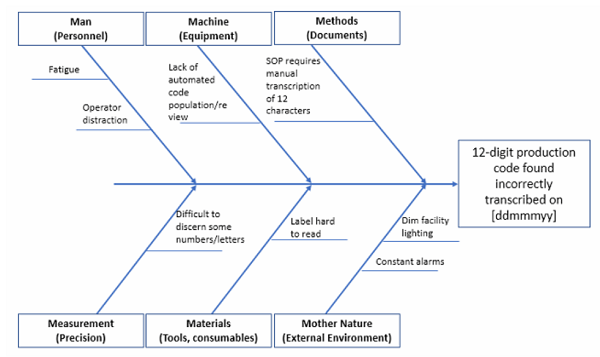
The Fishbone Diagram

To assist in overcoming the resistance to using structured problem-solving, an Ishikawa diagram, also known as a “cause and effect diagram” or a “fishbone diagram,” is a tool used to identify and analyze the root causes of a problem. It is named after its creator, Dr. Kaoru Ishikawa, who developed the method in the 1950s as a way to improve quality control in manufacturing. Today, it is widely used in a variety of industries, including healthcare, finance, and engineering, to help teams understand and solve problems more effectively.

To create an Ishikawa diagram, start by identifying the problem you are trying to solve and writing it at the head of the diagram. Then, draw a horizontal line branching off from the head of the diagram and label it with one of the six main categories of causes: people, methods, machines, materials, measurement, and environment. These categories represent the most common sources of problems and are meant to be used as a starting point for brainstorming.

Next, draw additional lines branching off from each of the main categories, and label them with specific causes that could be contributing to the problem. It is important to be as specific and detailed as possible, as this will help you identify the root cause of the problem more easily.

Once you have identified all of the potential causes, you can begin analyzing the data and looking for patterns or trends. This may involve collecting additional data, such as measurements or observations, or conducting experiments to test your hypotheses.

One of the key benefits of using an Ishikawa diagram is that it helps teams visualize the relationships between different causes and their potential impact on the problem. This can make it easier to identify the root cause of the problem, rather than just addressing the symptoms.

An Ishikawa diagram is a powerful tool for root cause analysis that can help teams understand and solve problems more effectively. By identifying the main categories of causes and brainstorming specific contributing factors, teams can use this method to identify the root cause of a problem and implement effective solutions.

Conclusion:

In conclusion, structured problem-solving is a valuable tool for effectively identifying and addressing problems. It allows for a logical and systematic approach that can help to ensure that the best solution is chosen and implemented. However, there are several factors that can prevent people from using this process, and it is important to be aware of these obstacles in order to overcome them and make the most of this problem-solving method.

The Shift Playbook

“How do we know what to improve if we don’t know what’s happening?”

Six Questions that Guarantee Your Daily Win

Using SPC or Statistical Process Control charting and basic time tracking for downtime/defects

The backstory is that we were in the middle of our ramp up phase in the new plant.  Managers, supervisors, and operators alike were all learning the equipment and production processes.  We were struggling to improve performance.  In a discussion with the team the comment was made – “how do we know what to improve if we don’t know what’s happening?”  We had machine data available. We have various HMI screens that give current machine performance. But, as a whole integrated production line, we did not have visibility of how everything worked together.

That gap birthed the shift playbook.  It was designed to give the supervisors a current state performance metric by capturing the hour by hour performance, visualizing the previous hour and the shift trend, identifying targets, and tracking abnormal conditions or events that led to downtime.

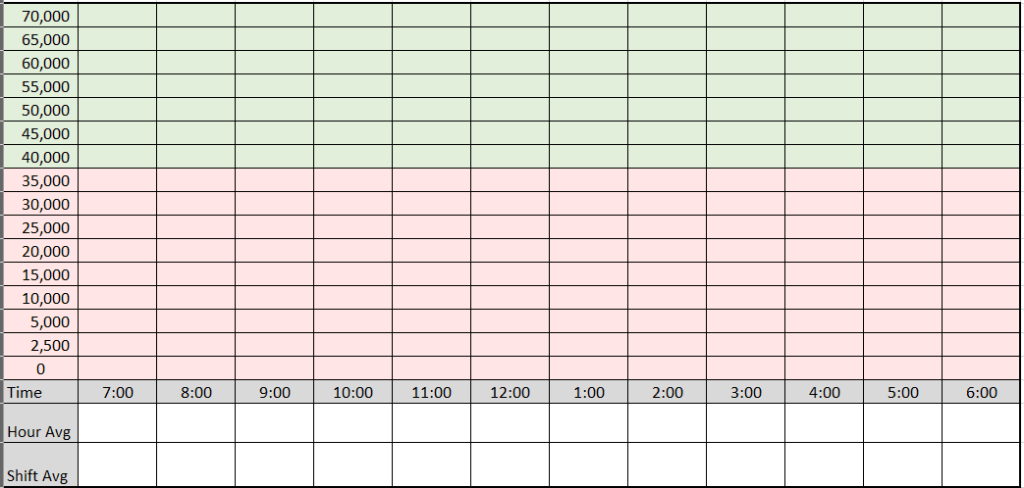
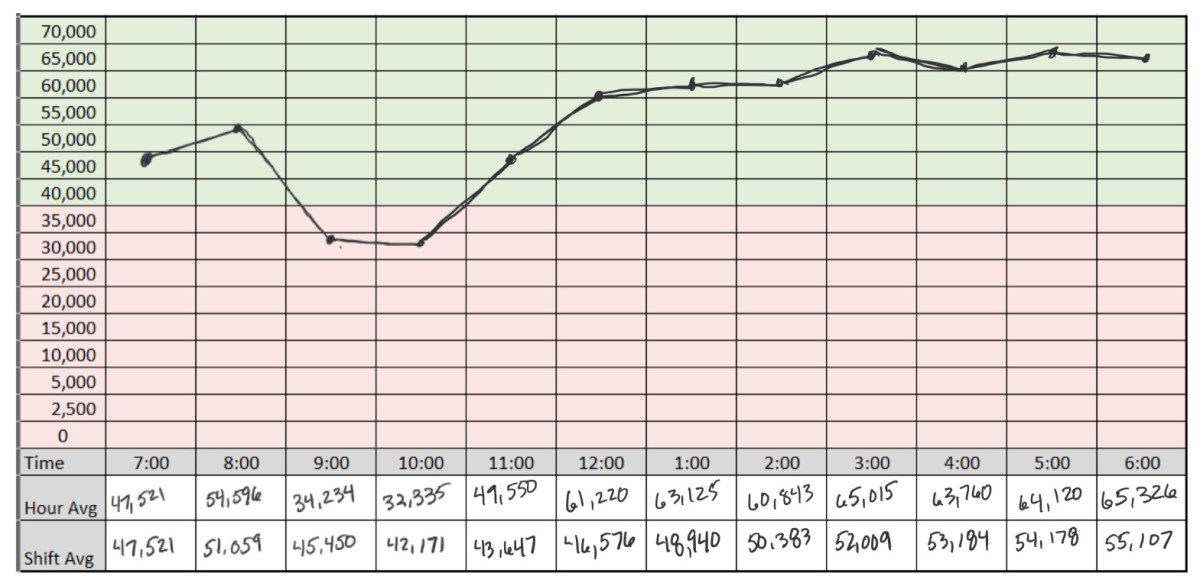
There are two parts.  The first one is a standard SPC chart that displays each hour slot of a twelve hour shift.  The minimum shift average of 40,000 parts per hour is designated by a change of color from green to red…simple yet genius

SPC Chart – The First Three Questions

The SPC chart is used to answer the following three questions:

  1. How did we do?
  2. How are we doing?
  3. If nothing changes – where will we end up?

How did we do?

Depending on your operation there can be differing amounts of variation in your production process.  Analyzing this particular process it was decided that hour by hour would be the optimal measurement and would allow some variability that occurs through each sixty minute cycle to normalized over time. 

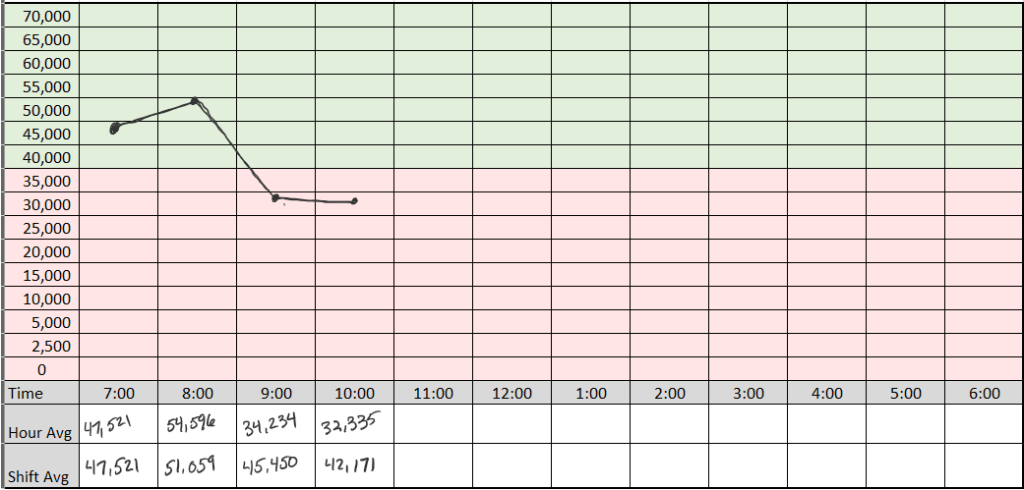
At the end of the hour, the supervisor places a dot on their playbook sheet in the closes square that represents the actual production performance number.  Plotting the following data would result in the following visual representation:

  • 06:00 – 07:00 – 47,521
  • 07:00 – 08:00 – 54,596
  • 08:00 – 09:00 – 34,234
  • 09:00 – 10:00 – 32,335

Answering the question “how did we do?” is easy when represented with a simple SPC chart.  We can see that we started off fine, things got better and then something happened that caused productivity to fall below our target minimum.

How are we doing?

We can also answer the question “how are we doing?’ by looking at the number in the shift average row.  We see that given the current hourly performance, the shift average is starting to go down.  It is easy to see that we are at risk.

If nothing changes – where will we end up?

A short while ago, I was doing a Gemba walk with the on-shift supervisor.  We reviewed the Shift Playbook for the current state.  It was a similar situation – the dots were pointing in a downward direction.  I called an all-hands meeting on the production floor with the supervisors and leads.  We looked at the playbook as a group.  When I asked the question – “If nothing changes where will we end up by the end of the shift?”  Everyone knew the answer.  If nothing changes we will either continue to decline or remain below goal for the shift.

That quick answer then led us to the next section of the playbook where we answer the second set of questions.

The Production Delay Log

The production delay log is a simple yet powerful tool when combined with the SPC chart above.  It helps answer these questions:

  1. What is getting in our way?
  2. What impact is it having?
  3. What do we need to focus on to improve?

We had decided as a team that just like tracking the hour by hour at a minimum, that there was too much noise and busyness to track every delay.  We aligned that we would only track incidents that resulted in delays greater than 10 minutes.  Your operation may be mature enough to tighten the interval for tracking but as a startup facility we found it more value added to address the larger items first. 

This would also keep us focusing on the critical items and not chasing everything.

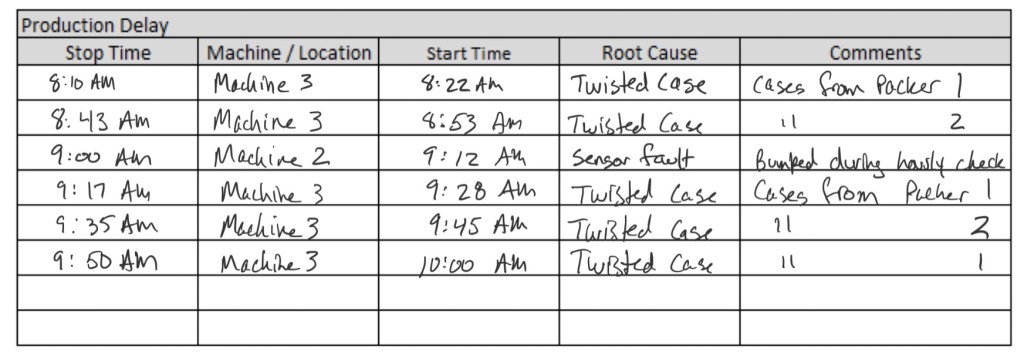
Reviewing a sample delay log that would match the SPC chart example above we would see the following:

By keeping a general production delay log the information from different machines or areas of the production line can be brought together to see if there are any patterns. 

The data answers the last two questions.  5/6 or 83% of our delay is caused by the occurrence of twisted cases getting to machine 3.  We can also see that of the total downtime, approximately 60 minutes – 50 minutes are caused by one type of incident. 

It is easy to see the pattern here.  When the team reviewed the playbook there was agreement that we need to Gemba machine 3 and see where the problem is coming from.

That is exactly what we did.  The whole team went to machine 3 to watch the delay happen.  While we were there we saw a twisted case arrive – already twisted.  We decided to move upstream.  We went to the next machine which was a combiner.  It takes two different source conveyors and combines them into one line a moves them to a palletizing machine.

We watched for about ten to fifteen minutes and then it happened.  We saw a case get hung up on one of the side / edge rollers that merged the case to the other line.  It didn’t happen every time but as we continued to watch we noticed that upon closer inspection, every case looked like it bumped something – it caused the case to shift slightly.  The severity of it was random.  Every ten to fifteen minutes it was severe enough to cause the case to turn 90 degrees and stop machine 3 downstream. 

We called maintenance right away who made a slight adjustment to the angle.  We then stayed to validate whether our hypothesis was correct.  The “bump” was gone and no repeats of the incident occurred over the next thirty minutes.

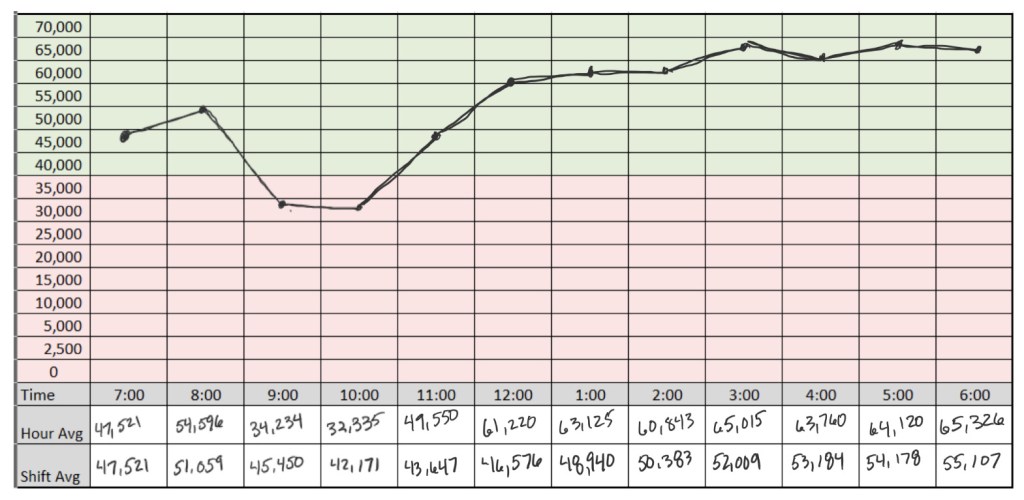
The playbook was completed with a much improved hour by hour and upward moving average.  By the end of the shift the team finished with the fifth highest shift production record as of that date.

Summary

Using and combining the two simple yet effective tools – an SPC chart and production delay log into a Shift Playbook can provide the data and visualization to help your team know what defines winning, understand the current state, and identify roadblocks that are preventing them from winning.