
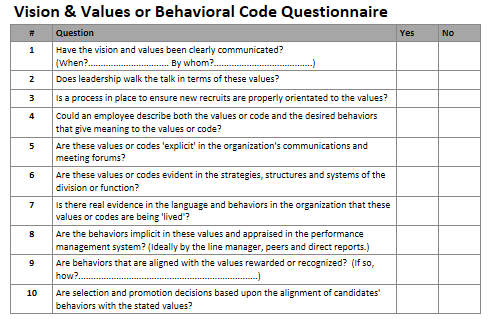
10 Essential Questions to Align Your Business Vision and Values for Success

For values to really stick, they need to be woven into the fabric of the organization.

When business changes consume excessive time and energy it’s easy to lose sight of what truly matters—your organization’s vision and values. But here’s the thing: without a clear understanding of these foundational elements, how can anyone expect to win the game? Just like a team that doesn’t know the rules can’t hope to succeed, an organization without well-communicated vision and values is destined for confusion and inefficiency.

Have the vision and values been clearly communicated? (When? By whom?)

Let’s start with the basics. Effective communication of vision and values is crucial. Imagine trying to play a game without knowing the rules. That’s what it’s like in an organization where the vision isn’t clear. According to a study by Kantabutra and Avery (2010), clear communication of vision boosts organizational performance and employee satisfaction. Think back: when was the last time your vision and values were communicated? Was it during a company-wide meeting by the CEO or in a detailed email from HR?

Citation:
Kantabutra, S., & Avery, G. C. (2010). “The power of vision: Statements that resonate with employees boost their motivation.” Leadership & Organization Development Journal, 31(1), 39-52. Link to the study

Does leadership walk the talk in terms of these values?

Next up is leadership. Their credibility hinges on actions aligning with words. It’s like a fitness instructor who never exercises—hypocrisy is easily spotted. Brown and Treviño (2006) emphasize that ethical leadership, where leaders embody the organization’s values, significantly influences employees’ behavior. So, does your leadership practice what they preach?

Citation:
Brown, M. E., & Treviño, L. K. (2006). “Ethical leadership: A review and future directions.” The Leadership Quarterly, 17(6), 595-616. Link to the study

Is there a process to ensure new recruits are properly orientated to the values?

Starting a new job is overwhelming. That’s why a solid orientation process is key. Bauer et al. (2007) found that well-structured onboarding processes help new employees stick around and perform better because they understand and align with the organization’s culture and values. Does your company ensure new hires grasp the values from day one?

Citation:
Bauer, T. N., Bodner, T., Erdogan, B., Truxillo, D. M., & Tucker, J. S. (2007). “Newcomer adjustment during organizational socialization: A meta-analytic review of antecedents, outcomes, and methods.” Journal of Applied Psychology, 92(3), 707-721. Link to the study

Could an employee describe both the values or code and the desired behaviors that give meaning to them?

It’s one thing to have values on a poster; it’s another for employees to live them. Schwartz (2013) points out that clear, codified values guide employee behavior and decision-making. If you asked a random employee, could they tell you what the company values are and what behaviors exemplify them?

Citation:
Schwartz, S. H. (2013). “An Overview of the Schwartz Theory of Basic Values.” Online Readings in Psychology and Culture, 2(1). Link to the study

Are these values or codes ‘explicit’ in the organization’s communications and meeting forums?

Making values explicit in communications keeps them top of mind. Schein (2010) emphasizes that clear communication is essential for embedding organizational culture. Are your values discussed in meetings, highlighted in newsletters, or prominently displayed in the office?

Citation:
Schein, E. H. (2010). “Organizational Culture and Leadership.” Jossey-Bass, 4th edition. Link to the book

Are these values or codes evident in the strategies, structures, and systems of the division or function?

For values to really stick, they need to be woven into the fabric of the organization. Kaplan and Norton (2004) discuss how aligning strategy with values drives performance and accountability. Are your company’s strategies, structures, and systems reflective of its core values?

Citation:
Kaplan, R. S., & Norton, D. P. (2004). “Strategy Maps: Converting Intangible Assets into Tangible Outcomes.” Harvard Business School Press. Link to the book

Is there real evidence in the language and behaviors in the organization that these values or codes are being ‘lived’?

Walking the talk is crucial. Cameron and Quinn (2011) explain that organizational culture is reflected in behaviors and norms. Do you see evidence of your values in the day-to-day language and actions within your organization?

Citation:
Cameron, K. S., & Quinn, R. E. (2011). “Diagnosing and Changing Organizational Culture: Based on the Competing Values Framework.” Jossey-Bass, 3rd edition. Link to the book

Are the behaviors implicit in these values appraised in the performance management system? (Ideally by the line manager, peers, and direct reports.)

Integrating values into performance reviews ensures consistent reinforcement. Aguinis (2013) discusses how performance management systems can be designed to evaluate and promote value-aligned behaviors. Are employees evaluated on how well they embody the company’s values?

Citation:
Aguinis, H. (2013). “Performance Management.” Pearson Education, 3rd edition. Link to the book

Are behaviors that are aligned with the values rewarded or recognized? (If so, how?)

Rewarding and recognizing value-aligned behaviors reinforces their importance. Podsakoff et al. (2000) highlight that organizational citizenship behaviors, which align with core values, can be encouraged through appropriate reward systems. Are there specific rewards or recognition programs for employees who live the company values?

Citation:
Podsakoff, P. M., MacKenzie, S. B., Paine, J. B., & Bachrach, D. G. (2000). “Organizational citizenship behaviors: A critical review of the theoretical and empirical literature and suggestions for future research.” Journal of Management, 26(3), 513-563. Link to the study

Are selection and promotion decisions based upon the alignment of candidates’ behaviors with the stated values?

Choosing and promoting based on value alignment ensures leadership consistency. Chatman and Cha (2003) discuss the importance of value congruence in selection and promotion processes. When considering candidates for promotion or hiring, are their behaviors and alignment with the company’s values taken into account?

Citation:
Chatman, J. A., & Cha, S. E. (2003). “Leading by leveraging culture.” California Management Review, 45(4), 20-34. Link to the study

Helpful Resources from Harvard Business Review

  1. How to Connect Employees to Your Company’s Purpose – Discusses the importance of communicating vision and values to connect employees to the company’s purpose.
  2. What New Team Leaders Should Do First – Highlights the significance of new leaders clearly communicating vision and values to their teams.
  3. 5 Types of Stories Leaders Need to Tell – Explores how storytelling can be used to communicate organizational values effectively.
  4. All in a Day’s Work – Emphasizes the role of leadership in communicating and garnering support for organizational vision and values.
  5. Six Components of a Great Corporate Culture – Discusses how vision and values are integral to building a strong corporate culture.
  6. Build a Culture That Aligns with People’s Values – Explains the importance of aligning corporate culture with employee values.
  7. How to Frame Your Messages for Maximum Impact – Provides insights on how leaders can effectively frame their vision to motivate teams.
  8. Leadership Is a Conversation – Highlights the necessity of open communication about organizational

If You Don’t Have This…..You Are Not Ready To Hire For Culture

Effective onboarding and training programs can help to bridge that gap and ensure that new hires are equipped to succeed in their new position.

“Culture eats strategy for breakfast.” In working with many entrepreneurs, I have found this to be very true, as the culture is the secret sauce that keeps employees motivated and clients happy. “

Jacob M. Engel “Why Does Culture ‘Eat Strategy For Breakfast?” Forbes.com Nov. 2018

Hiring for culture is important because it ensures that new employees fit in well with the existing team and company culture. While skills and experience are certainly important, they are not the only factors to consider when hiring. Here are some reasons why hiring for culture is often prioritized:

  1. Promotes team cohesion: Hiring employees who fit well with the company culture can help promote team cohesion and reduce the chances of conflicts arising due to personality clashes.
  2. Enhances job satisfaction: When employees share the same values and beliefs as their coworkers and the company, they are more likely to feel fulfilled in their work and have higher job satisfaction.
  3. Increases retention rates: Employees who fit in well with the company culture are more likely to stay with the company long-term, reducing turnover and associated costs.
  4. Encourages innovation: When employees share the same values and beliefs, they are more likely to work well together, share ideas, and collaborate. This can lead to greater innovation and creativity.

Of course, it’s important to strike a balance between culture fit and skill level or experience. It’s not enough to hire someone simply because they fit in well with the company culture if they lack the minimum necessary skills and experience for the job. However, when all other factors are equal, culture fit can be the deciding factor in making a successful hire.

3 Ways to Tell If You Are Hiring For Culture

  1. Look for candidates who share your company values: During the interview process, ask questions that are designed to reveal whether or not the candidate shares your company’s core values. For example, if teamwork is a key value at your company, you might ask the candidate to describe a time when they worked collaboratively with others to achieve a common goal.
  2. Assess the candidate’s personality: Personality tests and assessments can be useful tools for determining whether or not a candidate will fit in well with your company culture. These tests can provide insights into a candidate’s communication style, work preferences, and personality traits.
  3. Ask for references from former coworkers or managers: Speaking with former colleagues or managers can give you a better sense of how the candidate has interacted with others in a work setting. Ask questions about the candidate’s teamwork skills, communication style, and ability to fit in with the company culture.

Overall, hiring for culture is about finding candidates who will not only excel at the job but also thrive within the company environment. By focusing on candidates who share your company values, assessing their personality traits, and speaking with former colleagues or managers, you can increase the chances of making a successful cultural fit hire.

The Missing Ingredient to Hiring For Culture

Having effective onboarding, training, and development programs is also crucial for ensuring that new hires can thrive within your company culture. While hiring for culture fit is important, it’s not enough on its own.

Currently, we use a Team Member Training Matrix displayed with the critical Standard Work items along with corresponding SOP’s to ensure each skill set is covered by our training program.

It utilizes an incremental 25% completion criteria for progress tracking.

25% – SOP has been reviewed and signed

50% – Team member participates in the process

75% – Team members can complete the process with little or no supervision

100% – Team member is a subject matter expert and can train others

If you don’t have effective onboarding and training programs, you are not ready to hire for culture.

Richard Rich

Here are a few reasons why:

  1. Ensuring that new hires have the necessary skills: Even if you hire someone who is a great cultural fit, they may not have all of the skills necessary to excel in their new role. Effective onboarding and training programs can help to bridge that gap and ensure that new hires are equipped to succeed in their new position.
  2. Accelerating the learning curve: Even experienced hires may take some time to adjust to your company’s specific processes and workflows. By providing comprehensive training, you can help to accelerate the learning curve and reduce the time it takes for new hires to become fully productive.
  3. Fostering a sense of belonging: Effective onboarding programs can help new hires to feel welcomed and supported within your company culture. This can help to foster a sense of belonging and reduce the chances that the new hire will feel like an outsider.
  4. Supporting ongoing growth and development: Training and development programs can help to support ongoing growth and development for all employees, not just new hires. This can help to keep employees engaged and motivated over the long term.

In short, while hiring for culture fit is important, it’s only the first step in building a successful team. By pairing culture fit with effective onboarding, training, and development programs, you can set your new hires up for success and help to build a thriving company culture over the long term.

Rethink Your Retention Strategy

“The unfortunate outcome is that the people managers most want to retain feel constrained and become more likely to leave, risking the performance metrics they were so keen to protect in the first place.”

Keeping Good People Longer

As a business owner or manager, you’ve likely experienced the time, effort, and resources that go into onboarding and training a new employee. It can be frustrating when those investments don’t result in long-term retention, and turnover can disrupt the productivity and morale of your team.

Here are a few tips for improving new employee retention:

  1. Clearly communicate expectations: From the very beginning, set clear expectations for your new employee’s role and responsibilities. This includes outlining any performance goals and providing the necessary resources and support for them to succeed.
  2. Offer ongoing training and development: Continuous learning opportunities can help new employees feel valued and invested in. Consider offering in-house training, workshops, or even tuition reimbursement for relevant coursework.
  3. Foster a positive company culture: A positive work environment can make a big difference in employee satisfaction and retention. Encourage open communication, collaboration, and work-life balance to create a culture where employees feel supported and motivated.
  4. Seek and act on employee feedback: Regularly soliciting feedback from new employees can help you identify any challenges or concerns they may be facing. Use this feedback to make improvements and show your employees that their input is valued.
  5. Provide opportunities for advancement: Helping employees see a clear path for career growth and advancement within your company can be a strong motivator for retention. Consider offering leadership development programs or cross-functional training to help employees expand their skills and take on new challenges.

Overall, improving new employee retention requires a combination of clear communication, ongoing support, and creating a positive work environment. By taking these steps, you can help ensure that your new hires feel valued and motivated to stay with your company for the long-term.

What are the steps you or your organization is taking to keep good people around longer?