I Have All The Data But I Don’t Understand

By recognizing the differences and prioritizing insights and root causes, leaders can enhance their understanding of daily operations. Embracing strategies such as gemba walks, collaboration, data analytics, continuous learning, and mentoring relationships empowers leaders to unlock hidden potential and drive transformative change.

In the fast-paced world of manufacturing, production leaders face a constant influx of data. However, simply acquiring data is not enough to drive operational excellence. To make informed decisions and identify root causes, leaders must strive for a deep understanding of daily operations. In this blog post, we will explore the critical differences between data acquisition and true understanding. Additionally, we will provide practical strategies for manufacturing leaders to enhance their comprehension of daily operations.

1. Overwhelming Data: A Barrier to Effective Processing

In today’s manufacturing landscape, we are inundated with more data than we can effectively process. The sheer volume of information can overwhelm leaders, making it challenging to extract meaningful insights. Leaders must recognize that data alone does not equate to understanding. Instead, it serves as a foundation for deeper analysis and interpretation.

2. Grasping the Root Cause: The Key to Operational Constraint

To overcome operational challenges, leaders must fully understand the problems they encounter. Superficial knowledge of symptoms or surface-level analysis is insufficient. True understanding requires delving into the root cause and uncovering the underlying factors that contribute to constraints or inefficiencies. By addressing the root cause, leaders can implement targeted solutions and drive sustainable improvements.

3. Data vs. Understanding: Bridging the Gap

Recognizing the distinction between acquiring data and reaching a comprehensive understanding is crucial. Mere data acquisition involves collecting information without necessarily gaining insights. True understanding, on the other hand, involves analyzing data, recognizing patterns, and contextualizing the information. It is a cognitive process that leads to meaningful comprehension and informed decision-making.

4. Differentiating Data Acquisition from Understanding

To shed light on the disparities between data acquisition and understanding, let’s explore the key differences:

  • Depth of Analysis: Data acquisition involves collecting information at a surface level, while understanding requires diving deeper, analyzing patterns, and uncovering insights.
  • Contextual Understanding: Data acquisition may provide isolated facts, whereas understanding involves comprehending the context, interrelationships, and broader implications.
  • Interpretation and Synthesis: Understanding necessitates interpretation, synthesis, and connecting the dots between data points, enabling leaders to derive comprehensive insights.
  • Application and Problem-Solving: Data acquisition lacks the ability to apply knowledge to practical situations while understanding empowers leaders to address complex problems effectively.
  • Decision-Making: Understanding enables leaders to make informed decisions by considering various factors, weighing consequences, and assessing the long-term impact.

5. Strategies for Improving Operational Understanding

Manufacturing leaders can enhance their understanding of daily operations by implementing the following strategies:

  • Embrace Gemba Walks: Engage in regular visits to the shop floor to observe operations firsthand, ask questions, and gain a deeper understanding of processes and challenges.
  • Foster Cross-Functional Collaboration: Encourage collaboration between different departments and teams to gain a holistic view of operations, leverage diverse perspectives, and foster knowledge sharing.
  • Invest in Data Analytics: Utilize advanced data analytics tools and techniques to analyze large datasets, identify trends, and uncover meaningful insights that can drive informed decision-making.
  • Continuous Learning: Encourage a culture of continuous learning by providing training opportunities, promoting knowledge-sharing sessions, and encouraging personal development.
  • Develop Mentoring Relationships: Establish mentorship programs where experienced leaders can guide and share their insights with emerging leaders, facilitating knowledge transfer and deepening understanding.

Conclusion

In manufacturing leadership, true understanding surpasses mere data acquisition. It drives effective decision-making and operational excellence. By recognizing the differences and prioritizing insights and root causes, leaders can enhance their understanding of daily operations. Embracing strategies such as gemba walks, collaboration, data analytics, continuous learning, and mentoring relationships empowers leaders to unlock hidden potential and drive transformative change. With a deep understanding, manufacturing leaders navigate complexities with confidence, achieving lasting success.

Theory of Constraints Training Pack

Participants in TOC training programs may also learn about how to apply these concepts to real-world business situations, including how to identify and eliminate bottlenecks, how to set and achieve goals, and how to measure and improve organizational performance.

The Theory of Constraints (TOC) is a management philosophy developed by Eliyahu M. Goldratt that is designed to help organizations maximize their profits by identifying and eliminating bottlenecks that prevent them from reaching their full potential. It is based on the idea that every organization has a limited number of resources, such as time, money, and personnel, and that these resources are constrained by certain factors that limit their ability to produce results. By identifying and addressing these constraints, organizations can increase their efficiency and productivity and achieve their desired outcomes.

Training in TOC typically involves learning about the principles and tools of the theory, including the Five Focusing Steps, the Thinking Processes, and the Drum-Buffer-Rope (DBR) scheduling system. Participants in TOC training programs may also learn about how to apply these concepts to real-world business situations, including how to identify and eliminate bottlenecks, how to set and achieve goals, and how to measure and improve organizational performance.

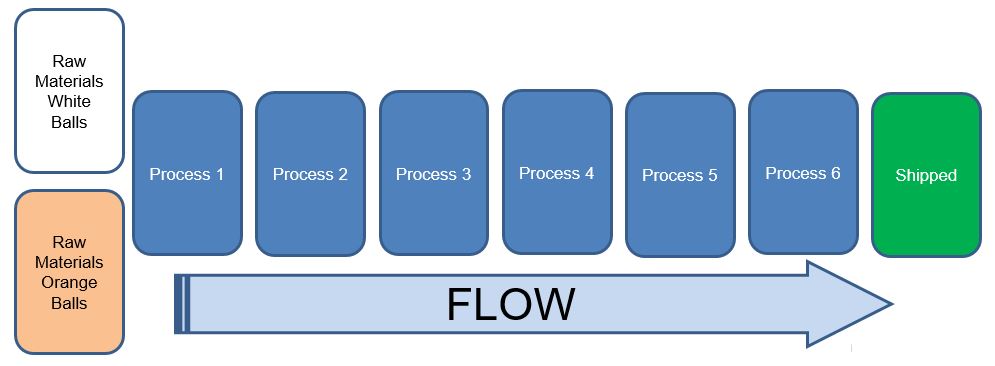
Below is a training deck/game created to help you – the Lean Leader – train your team on the identification of bottlenecks and how to address the constraints as you move closer to optimizing your production or manufacturing process.

This training kit is designed to give your team a hands-on experience with random process variation.

Supplies / Materials

  • 3 Sets of Dice
    • 1 White – to match white ping pong balls
    • 1 Orange – to match orange ping pong balls
    • 1 Blue – to represent Overtime
  • 9 Containers or bins
    • 1 for each of the 6 processes
    • 1 for the raw materials (before process 1)
    • 1 to receive “shipped” ping pong balls
  • 2 Flip chart sheets
    • 1 to draw the “Shipped” KPI and MTD Variance KPI
    • 1 to track “Bonus” points

Participants – for Role Play

  • 6 Supervisors – Manage each operation (bowl)
  • 1 General Manager – Controls cost through overtime and supermarket (inventory) approvals
  • 2 Manufacturing Managers – each one manages 3 supervisors
  • 1 Customer – responds positively or negatively to throughput/delivery of each roll

Game Setup

  • 2 Bins of Raw Materials (ping pong balls)
  • 6 Stations = 1 Person per 1 Process Container + 1 Die
  • 3 Balls (Beginning Inventory) at each Process (in each bowl to start)
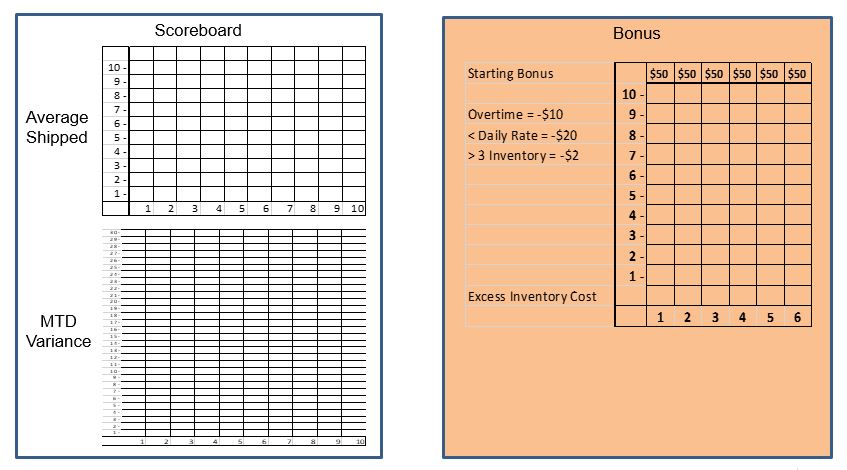
  • 6 Flip Chart Sheets (or printed 11×17)  – 5 Scoreboards and 1 Bonus

The accompanying Excel sheet contains printable examples on 11″x17″ size paper.

Game Play – 7 Rounds (10 rolls each process) + Bonus Round

Round 1 – Basic

Rules

  1. Each person will roll their die 1 x 10
  2. The number rolled represents production for the day
  3. They will pass that number of balls to the next process −If there are not enough balls in their inventory then they pass only the number available
  4. The scorekeeper will write down the actual shipments (chart 1) and the cumulative shipments (chart 2)

Observations

  1. Note the random variation in inventory levels
  2. Note the strain on flow through the value stream
  3. Note the inconsistency of shipments (chart 1)
  4. Note the increasing variance to target (chart 2)

Round 2 – Improvement #1 – Add 1 Inventory Supermarket

Rules

  1. The team will decide (majority wins) to place one supermarket of inventory( 3 days worth or 9 balls) at a strategic location between any two processes
  2. Each person will roll their die 1 x 10
  3. The number rolled represents production for the day
  4. They will pass that number of balls to the next process −If there are not enough balls in their inventory then they pass only the number available
  5. The scorekeeper will write down the actual shipments (chart 1) and the cumulative shipments (chart 2)

Observations

  1. Note the reduction of variation near the supermarket
  2. Note the strain on flow through the value stream
  3. Note the inconsistency of shipments (chart 1)
  4. Note the increasing variance to target (chart 2)

Round 3 – Firefighting #1 – Add Labor Sharing

Rules

  1. Setup the game the same as the previous round
  2. Each person will roll their die 1 x 10
  3. The number rolled represents production for the day
  4. They will pass that number of balls to the next process
    • If there are not enough balls in their inventory then they pass only the number available
    • A process that has excess inventory can choose to not roll a turn and loan labor (forfeit their roll and pass their die to another process) that needs an additional roll to be able to move more inventory
  5. The scorekeeper will write down the actual shipments (chart 1) and the cumulative shipments (chart 2)

Observations

  1. Note the reduction of variation near the supermarket
  2. Note the strain on flow through the value stream
  3. Note the inconsistency of shipments (chart 1)
  4. Note the increasing variance to target (chart 2)

Round 4 – Firefighting #2 – Add Overtime (3 Blue Die – Max per round)

Rules

  1. Setup the game the same as the previous round
  2. Each person will roll their die 1 x 10
  3. The number rolled represents production for the day
  4. They will pass that number of balls to the next process
    • If there are not enough balls in their inventory then they pass only the number available
    • If there are not enough balls in their inventory then they pass only the number available
    • Another process that has excess inventory can choose to not roll and loan labor (forfeit their roll and pass their die to another process) that needs to move more inventory
  5. If the roll results in a number too low, the participant can request (from the manager) to use an available Overtime roll to make the production rate for the round
    1. There is a maximum of 3 Overtime rolls per round
  6. The scorekeeper will write down the actual shipments (chart 1) and the cumulative shipments (chart 2)

Round 5 – Merit / Bonus Round

Rules

  1. Same as the previous Round
  2. Each person starts out with a $50 Bonus
  3. The scorekeeper subtracts the following penalties from each person during the round:
    • Overtime – $10.00
    • Not hitting Daily Rate – $20.00
    • Greater than 3 balls of ending inventory – $1.00
  4. The winner is the player with the most bonus points

Observations

  1. What changed?
  2. Did anything improve?
  3. Is Labor sharing or Overtime sustainable or ideal?

Summary

This training event is an opportunity to review the key concepts and principles of TOC and how they can be applied in participants’ organizations.

At the conclusion of the training, participants should have a clear understanding of the TOC philosophy and how it can be used to identify and eliminate bottlenecks that prevent organizations from reaching their full potential. They should also have the knowledge and skills to set and achieve goals, measure and improve organizational performance, and apply the TOC tools and techniques to real-world business situations.

Participants may have the opportunity to share their thoughts and experiences with the TOC philosophy and how they plan to use it in their organizations. They may also have the opportunity to ask questions and seek guidance from the instructor and other participants.

5 Proven Steps for Effectively Solving Problems

Structured problem-solving is a valuable tool for effectively identifying and addressing problems. It allows for a logical and systematic approach that can help to ensure that the best solution is chosen and implemented. However, there are several factors that can prevent people from using this process, and it is important to be aware of these obstacles in order to overcome them and make the most of this problem-solving method.

Structured problem-solving is a systematic process for identifying and resolving problems. It involves defining the problem, generating potential solutions, evaluating those solutions, choosing the best one, and implementing and testing it. However, there are several reasons why people may not use this approach, including a lack of time, a lack of understanding, personal biases, group dynamics, and resistance to change.

The 5 Steps:

  1. Define the problem clearly and accurately
  2. Generate potential solutions
  3. Evaluate the potential solutions
  4. Choose the best solution
  5. Implement and test the solution

Clarification of Each Strategy

  1. Defining the problem clearly and accurately is the first step in effective problem-solving. This involves understanding the root cause of the problem and identifying any underlying issues that may be contributing to it.
  2. Generating potential solutions involves coming up with as many ideas as possible for addressing the problem. This can be done through brainstorming sessions with a team or individually.
  3. Evaluating the potential solutions involves analyzing each solution and considering its pros and cons. This helps to determine which solution is the most viable.
  4. Choosing the best solution involves selecting the solution that is most likely to effectively address the problem and meet the desired outcomes.
  5. Implementing and testing the solution involves putting the chosen solution into action and evaluating its effectiveness. This may involve making adjustments or trying a different solution if the initial one does not produce the desired results.

Resistance to Structured Problem-Solving

There are several reasons why people may not use structured problem-solving:

  1. Lack of time: Sometimes, people may feel that they do not have the time to follow a structured problem-solving process. They may feel pressure to come up with a solution quickly and may skip steps in order to do so.
  2. Lack of understanding: Some people may not understand the value of structured problem-solving or may not know how to use the process effectively.
  3. Personal biases: People may have their own biases or preconceived notions that prevent them from considering all possible solutions or evaluating them objectively.
  4. Group dynamics: In a group setting, there may be social pressures or dynamics at play that prevent people from fully participating in the problem-solving process.
  5. Resistance to change: Some people may be resistant to trying new approaches or may be comfortable with their existing ways of problem-solving, even if they are not the most effective.

The Fishbone Diagram

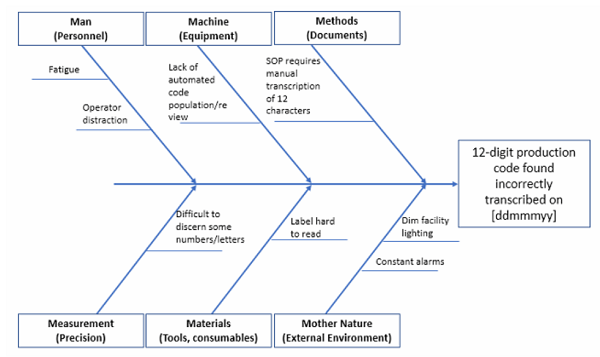
To assist in overcoming the resistance to using structured problem-solving, an Ishikawa diagram, also known as a “cause and effect diagram” or a “fishbone diagram,” is a tool used to identify and analyze the root causes of a problem. It is named after its creator, Dr. Kaoru Ishikawa, who developed the method in the 1950s as a way to improve quality control in manufacturing. Today, it is widely used in a variety of industries, including healthcare, finance, and engineering, to help teams understand and solve problems more effectively.

To create an Ishikawa diagram, start by identifying the problem you are trying to solve and writing it at the head of the diagram. Then, draw a horizontal line branching off from the head of the diagram and label it with one of the six main categories of causes: people, methods, machines, materials, measurement, and environment. These categories represent the most common sources of problems and are meant to be used as a starting point for brainstorming.

Next, draw additional lines branching off from each of the main categories, and label them with specific causes that could be contributing to the problem. It is important to be as specific and detailed as possible, as this will help you identify the root cause of the problem more easily.

Once you have identified all of the potential causes, you can begin analyzing the data and looking for patterns or trends. This may involve collecting additional data, such as measurements or observations, or conducting experiments to test your hypotheses.

One of the key benefits of using an Ishikawa diagram is that it helps teams visualize the relationships between different causes and their potential impact on the problem. This can make it easier to identify the root cause of the problem, rather than just addressing the symptoms.

An Ishikawa diagram is a powerful tool for root cause analysis that can help teams understand and solve problems more effectively. By identifying the main categories of causes and brainstorming specific contributing factors, teams can use this method to identify the root cause of a problem and implement effective solutions.

Conclusion:

In conclusion, structured problem-solving is a valuable tool for effectively identifying and addressing problems. It allows for a logical and systematic approach that can help to ensure that the best solution is chosen and implemented. However, there are several factors that can prevent people from using this process, and it is important to be aware of these obstacles in order to overcome them and make the most of this problem-solving method.