New Year, New Leader Standard Work (LSW)

When implementing LSW in a production environment, it is important to involve all members of the production team in the process. This can help to ensure that everyone has a clear understanding of their roles and responsibilities and that they are fully committed to the implementation of LSW.

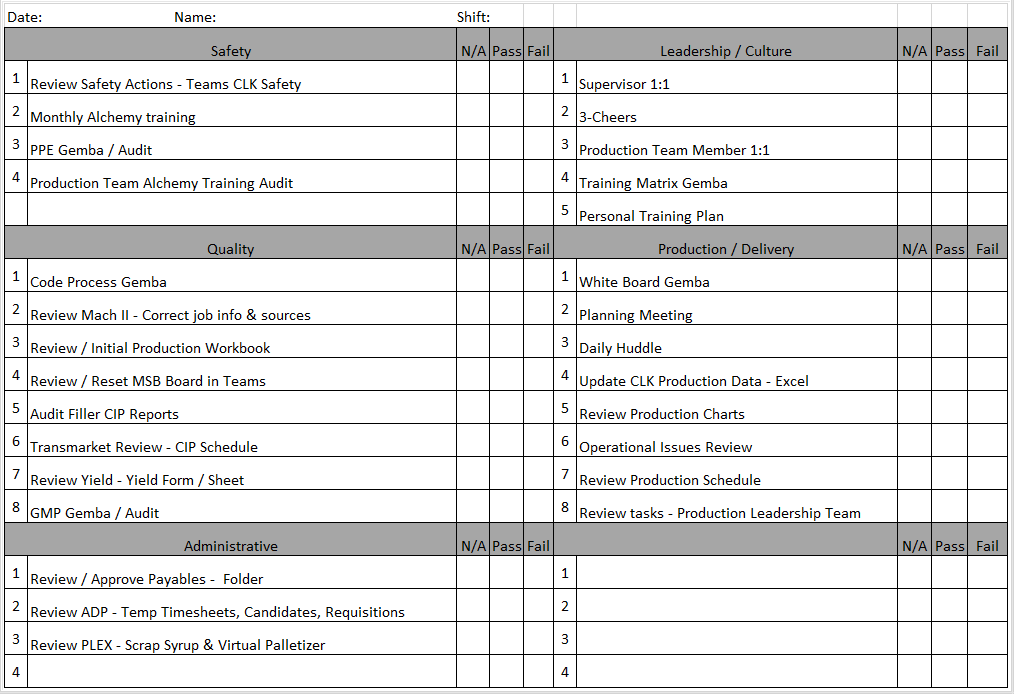
It is that time of the year again. Reviewing budgets, strategies, etc. One thing that I am currently working on is updating my Leader Standard Work to align with our updated goals for 2023.

Leader Standard Work (LSW) is a tool that can be used to effectively manage production systems. It is a set of procedures and processes that outline the specific tasks and responsibilities of leaders and managers in a production environment. By following LSW, leaders and managers can ensure that their teams have the necessary information and resources to perform their jobs effectively and efficiently.

One of the key benefits of LSW is that it helps to standardize the way that work is done in a production environment. This can help to reduce variability and improve the overall quality of the products or services being produced. It also helps to ensure that all employees are working to the same standards, which can improve communication and collaboration among team members.

Another benefit of LSW is that it helps to ensure that leaders and managers are aware of any issues or problems that may arise in the production process. This can help them to quickly identify and address any problems, which can help to prevent delays and minimize the impact of any disruptions to the production process.

When implementing LSW in a production environment, it is important to involve all members of the production team in the process. This can help to ensure that everyone has a clear understanding of their roles and responsibilities and that they are fully committed to the implementation of LSW. It is also important to provide training and resources to employees, to help them understand and effectively implement the new procedures and processes.

Here is the draft LSW that I am working with.

To effectively monitor and maintain LSW, management must establish visual management systems such as Andon, KPI boards and process mapping. These visual tools helps to track the performance of the processes, identify problems and quickly address them. The data from the visual management systems is used for continuous improvement and to make necessary adjustments to the LSW procedures.

Overall, LSW is a powerful tool for managing production systems and can help to improve the efficiency and quality of the production process. By standardizing the way that work is done, leaders and managers can ensure that their teams have the necessary information and resources to perform their jobs effectively and efficiently. Additionally, LSW can be used to quickly identify and address any issues that may arise in the production process, helping to prevent delays and minimize the impact of disruptions.

4 Rules of Process: Rule #4

If a process is not measured with reliable data, it can be difficult to accurately assess its effectiveness or identify areas for improvement. This is because the data being used to evaluate the process may be incomplete, inaccurate, or biased, which can lead to incorrect conclusions being drawn.

It must be measured to understand its results

Measuring the results of a process is important for a number of reasons. Here are a few:

  • It allows you to understand if the process is effective: By tracking and measuring the results of a process, you can determine whether or not it is achieving the desired outcomes. This can help you understand if the process is working as intended and if any adjustments need to be made.
  • It helps you identify areas for improvement: By regularly reviewing the results of a process, you can identify areas where the process may be falling short or where there is room for improvement. This can help you make changes to the process that will result in better outcomes.
  • It helps you optimize the process: By tracking and measuring the results of a process over time, you can identify trends and patterns that can help you optimize the process. For example, you may discover that a certain step in the process is taking longer than necessary, or that a certain type of input is consistently producing better results. By making adjustments based on this data, you can improve the overall efficiency and effectiveness of the process.

Breaking Rule #4

If a process is not measured with reliable data, it can be difficult to accurately assess its effectiveness or identify areas for improvement. This is because the data being used to evaluate the process may be incomplete, inaccurate, or biased, which can lead to incorrect conclusions being drawn.

For example, if you are trying to assess the effectiveness of a new process but you are only measuring a few key performance indicators (KPIs), you may be missing important information about how the process is performing in other areas. This could lead you to make changes to the process that are not actually necessary, or to miss opportunities for improvement that could have a significant impact.

On the other hand, if you are measuring a wide range of KPIs and collecting data from multiple sources, you are more likely to get a more complete and accurate picture of how the process is performing. This can help you make informed decisions about how to optimize the process and achieve better results.

Overall, it’s important to carefully consider how you will measure the results of a process to ensure that you are using reliable data to guide your decision-making.

Summary:

There are a few different ways you can measure the results of a process. One is to set performance targets and track progress against them. For example, if your goal is to reduce the time required to complete a certain task, you might set a target for how much time you want to save and track your progress over time. Another is to collect feedback from those who are carrying out the work. This can help you understand their perspective and identify any issues or challenges they are facing. Finally, you can analyze data related to the process, such as the volume of work being completed or the number of errors being made. This can help you understand the overall performance of the process and identify trends or patterns that can be addressed.

4 Rules of Process: Rule #3

If a process isn’t easy to follow because of various obstacles (problems with equipment, materials, schedules, instructions, etc.) workers will be forced to work “around the system” to get the job done; this will produce differing results.

It must be easy to execute on the job

About four weeks prior to this post we had a technical service person from the equipment manufacturer onsite working with us on some process and programming improvements we requested to be completed. It was towards the end of the week and he would be leaving after the next day.

He was able to witness one of our processes where we filled some generic cans with just water. That water is tested by our lab for sanitation specifications. It was a simple process – if you knew how to do it. What was required was to follow a specific sequence of manually opening valves using an HMI (Human Machine Interface) screen. Filling the cans. Then reversing the process so any excess water could be drained.

One problem…if you were unfamiliar with the screen pictured above – an “easy” 3 step process can be challenging to execute. Imagine how you’d feel looking at all the icons on the screen and not knowing which ones to press or what risk there is to selecting the wrong ones. Daunting right?

Breaking Rule #3

If a process isn’t easy to follow because of various obstacles (problems with equipment, materials, schedules, instructions, etc.) workers will be forced to work “around the system” to get the job done; this will produce differing results.

Making a process easy to execute on the job is important for a number of reasons. Here are a few:

  • It reduces the risk of errors: When a process is easy to follow, it’s less likely that mistakes will be made. This can help to improve the quality of the work and reduce the need for rework or corrections.
  • It saves time: When a process is easy to follow, it can be completed more efficiently. This can help to reduce the time required to complete the work, which can be especially important in fast-paced or time-sensitive situations.
  • It improves morale: When a process is easy to follow, it can be less frustrating for those carrying out the work. This can help to improve morale and increase job satisfaction, which can have a positive impact on team performance.

There are a few things that can be done to make a process easy to execute on the job. One is to break down complex tasks into smaller, more manageable steps. This can make it easier for those carrying out the work to understand what needs to be done and how to do it. Another is to provide the necessary resources and tools to make the work easier. This could include things like clear instructions, templates, or specialized equipment. Finally, it’s important to ensure that those carrying out the work have received proper training and understand the process fully. This can help to reduce confusion and improve efficiency.

4 Rules of Process: Rule #2

When we create or update processes and they are not fully understood by the people doing the work, they will find ways to get the work done based on their own experiences. Evidence of this is when you try to train someone with different people and the trainer remarks “we don’t do it that way on our shift.” LOL. This is probably heard more often than not.

It must be understood by those doing the work

It was Friday night November 5th. Several planning sessions were held the few days prior showing some statistics, trends, and other data to create a plan to optimize the weekend production run for a national customer of ours. About 11:30 PM I received the phone call from a seemingly nervous Batching Technician.

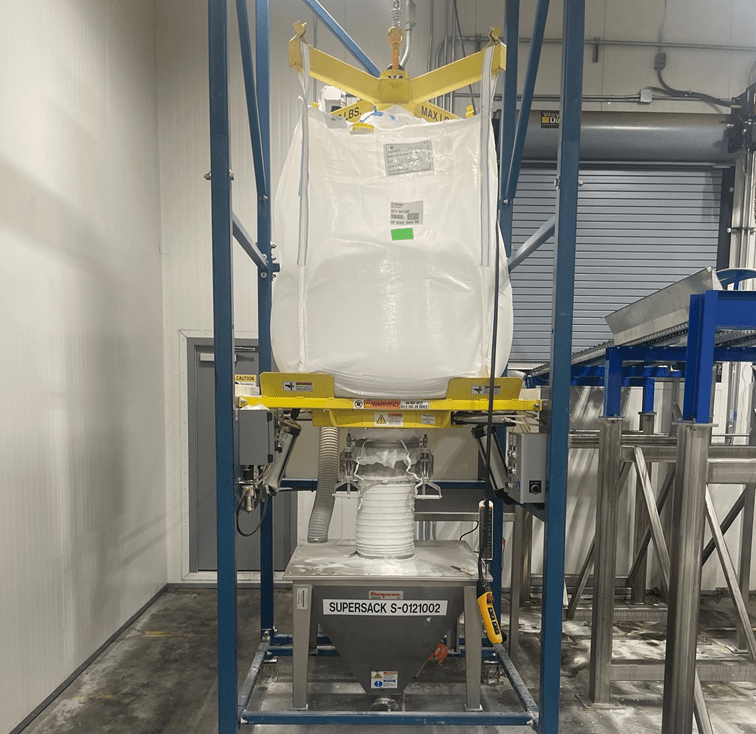
We were planning on transitioning from multiple pallets of #50 bags, very laborsome, to #2,000 super sacks where most of the labor would be done by a machine, except for one hiccup. The technician didn’t understand the process of how to use it.

But we were not ready for that yet. We had an internal agreement to delay the implementation due to some previous issues. Now, however, we were possibly being forced to move forward with the process.

The SOP Dilemma

I read through the SOP. It didn’t seem that difficult but then again, I will not be in the plant at 1:15 AM when they attempt to load the ingredient. I am not a fan when it comes to SOP’s. I align and agree that they serve a purpose in that they can document a process but too often they are miscategorized as a “training tool.” Fully support their use for ISO Standards and audits, etc. But when it comes to skill building in a competency matrix type of paradigm, their use is more for a general introduction and not in skill building.

Breaking Rule #2

If a process isn’t fully understood, it will result in individuals developing their own understanding of the process based on “educated guesses” and “trial and error.

Without a full understanding of this mixing process, we were at risk. We aren’t creating small batches or parts. We are mixing batches of liquids up to 15,000 gallons. To make a mistake would require scrapping an entire production order and facing a possible claim. This is unacceptable. But this is true of any industry or process.

When we create or update processes and they are not fully understood by the people doing the work, they will find ways to get the work done based on their own experiences. Evidence of this is when you try to train someone with different people and the trainer remarks “we don’t do it that way on our shift.” LOL. This is probably heard more often than not.

Back to our process. A mechanical delay caused just enough of a slow down that when we got to the point of needing to start this bulk mixing process, the early morning dayshift leader had already arrived. He had a lot of experience and was familiar with it. Needless to say, the batch went off without a hitch – or mistake! We focused on getting each team member familiar and fully understanding how to use the bulk mixer for supersacks.

4 Rules of Process: Rule #1

“This approach is not unilateral however. It is necessary to play catch ball with those who will be doing the work. This will ensure they buy in to the process but it is up to the leader to define the parameters to make sure no effort is wasted.”

Rule #1 – It must be defined by those planning the work

This is the foundation of good process.  In my experience with developing Standard Work and Leader Standard work, there have been variations on how to approach creating a process that is stable, repeatable, and effective to where the process produces the planned results.

One approach is very “hands off” where leaders delegate the formation and implementation to those actually doing the work.  At first this sounds like an empowering approach but in reality it almost never works for standardization.

It usually occurs in actions and activities that are not aligned with the higher level strategy; a lot of effort and actions but little value or contribution the KPI or other metrics.

A better way is to, as the leader, own the definition of the process by answering one or more of the following questions:

  1. What problem are we trying to solve?
  2. What value is it trying to add?
  3. What outcome is intended?
  4. How will completion directly impact the target?

This approach is not unilateral however.  It is necessary to play catch ball with those who will be doing the work.  This will ensure they buy in to the process but it is up to the leader to define the parameters to make sure no effort is wasted.

Breaking Rule #1

If a process is not clearly defined, it will be up to the individual worker to know how to get the job done; this means that the process will be done differently by different people

A short time ago it became necessary to be present on the production floor for the night shift.  Though a significant interruption to my normal schedule I welcomed the opportunity to observe a different shift / team perform the same activities.

It was interesting to talk to the operator through the changeovers and startups.  They were aligned with the end goal – minimizing downtime during changeovers.  The difference was how to get there.

The night shift operator did many of the same tasks , however, in a different order.  But, they also did some of the steps differently.  The data would support, less efficiently and effectively.

Fortunately the operator was open to some input and best practice sharing.  To top it off, the next hour was the second highest production rate ever recorded since our startup 1.5 years ago.

Defining the process for the operator enable them to run at a rate they had never run before.

Kudos to the team and kudos to the 1st rule of process – It must be defined by those planning the work.

A Summary of the 4 Rules of Process

“If a process is not clearly defined, it will be up to the individual worker to know how to get the job done; this means that the process will be done differently by different people”

I was reviewing my notes looking for these 4 rules of process. I remembered writing them down and then formulating my playbook and tools after them. Recently I wanted to go back to the original source. I found my notes but could not find the source or citation. This work is not my own but I cannot locate the source.

This series of blog posts will go through the 4 rules of process and explain their importance to real-world value stream improvement and efficiency gains.

4 Rules of Process

  1. It must be defined by those planning the work
  2. It must be understood by those doing the work
  3. It must be easy to execute on the job
  4. It must be measured to understand its results

Examples of ineffectiveness – Breaking the Rules of Process

  1. If a process is not clearly defined, it will be up to the individual worker to know how to get the job done; this means that the process will be done differently by different people
  2. If a process isn’t fully understood, it will result in individuals developing their own understanding of the process based on “educated guesses” and “trial and error.”
  3. If a process isn’t easy to follow because of various obstacles (problems with equipment, materials, schedules, instructions, etc.) workers will be forced to work “around the system” to get the job done; this will produce differing results.
  4. If a process is not measured with reliable data, no one will really know how well results are being achieved and whether or not changes to the process should be made.

The Shift Playbook

“How do we know what to improve if we don’t know what’s happening?”

Six Questions that Guarantee Your Daily Win

Using SPC or Statistical Process Control charting and basic time tracking for downtime/defects

The backstory is that we were in the middle of our ramp up phase in the new plant.  Managers, supervisors, and operators alike were all learning the equipment and production processes.  We were struggling to improve performance.  In a discussion with the team the comment was made – “how do we know what to improve if we don’t know what’s happening?”  We had machine data available. We have various HMI screens that give current machine performance. But, as a whole integrated production line, we did not have visibility of how everything worked together.

That gap birthed the shift playbook.  It was designed to give the supervisors a current state performance metric by capturing the hour by hour performance, visualizing the previous hour and the shift trend, identifying targets, and tracking abnormal conditions or events that led to downtime.

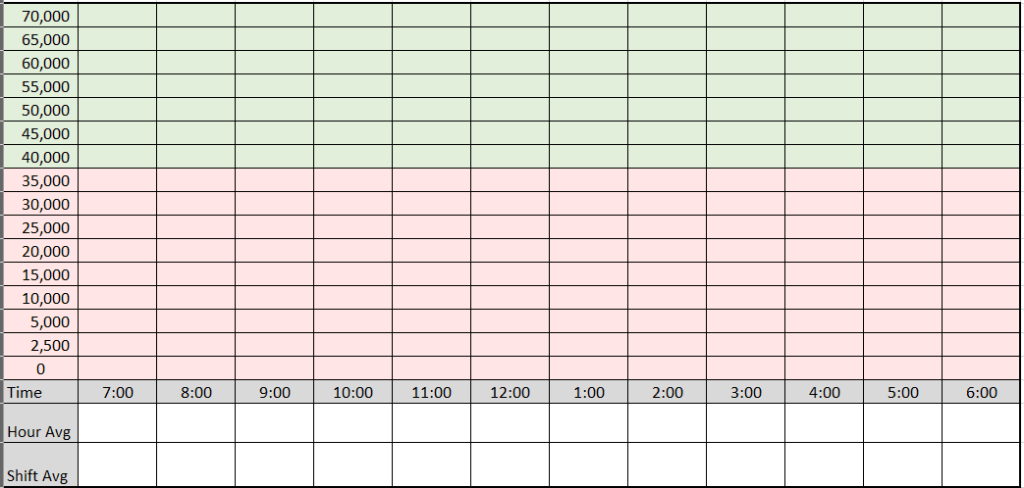
There are two parts.  The first one is a standard SPC chart that displays each hour slot of a twelve hour shift.  The minimum shift average of 40,000 parts per hour is designated by a change of color from green to red…simple yet genius

SPC Chart – The First Three Questions

The SPC chart is used to answer the following three questions:

  1. How did we do?
  2. How are we doing?
  3. If nothing changes – where will we end up?

How did we do?

Depending on your operation there can be differing amounts of variation in your production process.  Analyzing this particular process it was decided that hour by hour would be the optimal measurement and would allow some variability that occurs through each sixty minute cycle to normalized over time. 

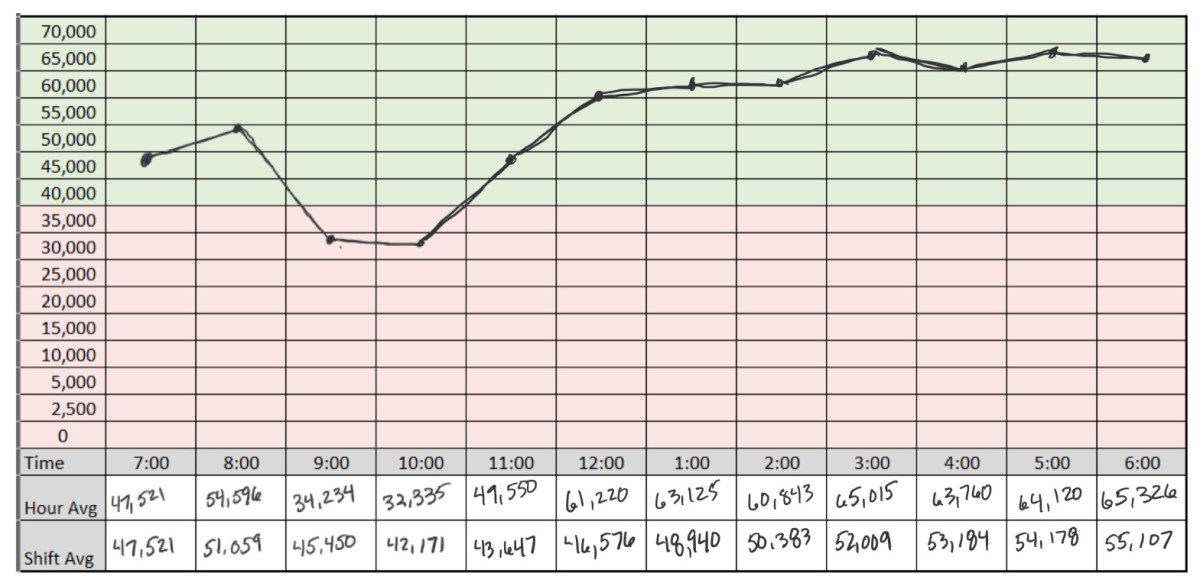
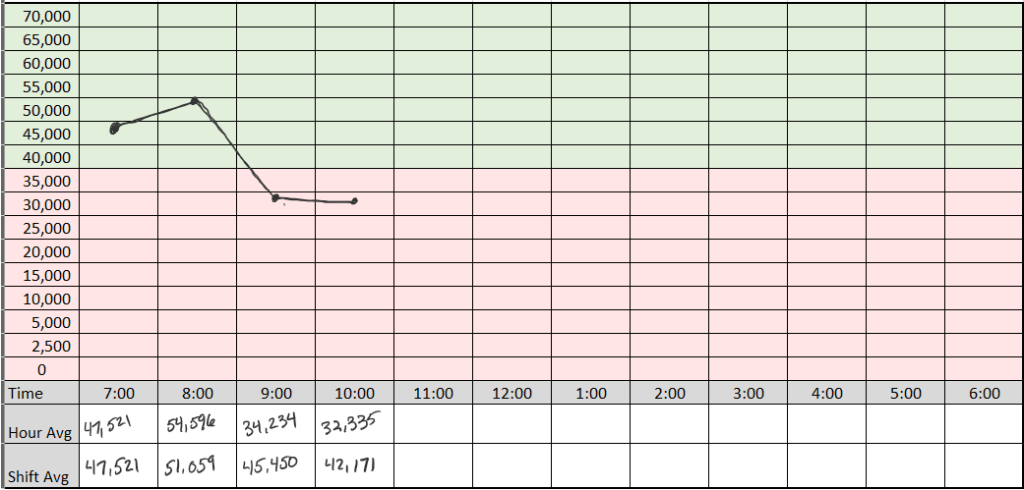
At the end of the hour, the supervisor places a dot on their playbook sheet in the closes square that represents the actual production performance number.  Plotting the following data would result in the following visual representation:

  • 06:00 – 07:00 – 47,521
  • 07:00 – 08:00 – 54,596
  • 08:00 – 09:00 – 34,234
  • 09:00 – 10:00 – 32,335

Answering the question “how did we do?” is easy when represented with a simple SPC chart.  We can see that we started off fine, things got better and then something happened that caused productivity to fall below our target minimum.

How are we doing?

We can also answer the question “how are we doing?’ by looking at the number in the shift average row.  We see that given the current hourly performance, the shift average is starting to go down.  It is easy to see that we are at risk.

If nothing changes – where will we end up?

A short while ago, I was doing a Gemba walk with the on-shift supervisor.  We reviewed the Shift Playbook for the current state.  It was a similar situation – the dots were pointing in a downward direction.  I called an all-hands meeting on the production floor with the supervisors and leads.  We looked at the playbook as a group.  When I asked the question – “If nothing changes where will we end up by the end of the shift?”  Everyone knew the answer.  If nothing changes we will either continue to decline or remain below goal for the shift.

That quick answer then led us to the next section of the playbook where we answer the second set of questions.

The Production Delay Log

The production delay log is a simple yet powerful tool when combined with the SPC chart above.  It helps answer these questions:

  1. What is getting in our way?
  2. What impact is it having?
  3. What do we need to focus on to improve?

We had decided as a team that just like tracking the hour by hour at a minimum, that there was too much noise and busyness to track every delay.  We aligned that we would only track incidents that resulted in delays greater than 10 minutes.  Your operation may be mature enough to tighten the interval for tracking but as a startup facility we found it more value added to address the larger items first. 

This would also keep us focusing on the critical items and not chasing everything.

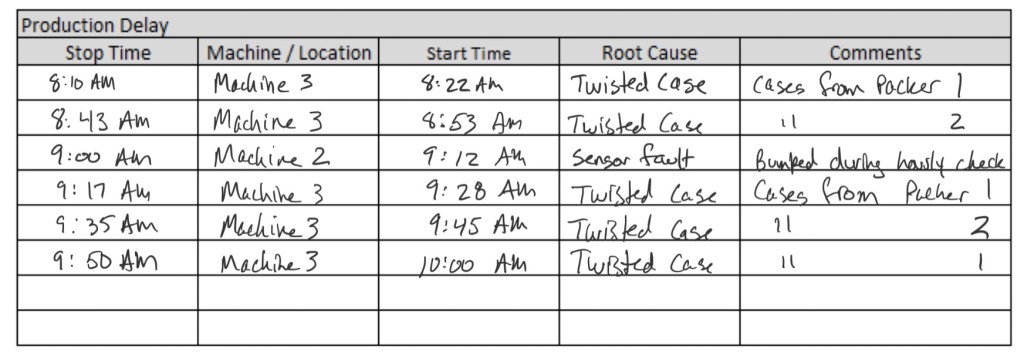
Reviewing a sample delay log that would match the SPC chart example above we would see the following:

By keeping a general production delay log the information from different machines or areas of the production line can be brought together to see if there are any patterns. 

The data answers the last two questions.  5/6 or 83% of our delay is caused by the occurrence of twisted cases getting to machine 3.  We can also see that of the total downtime, approximately 60 minutes – 50 minutes are caused by one type of incident. 

It is easy to see the pattern here.  When the team reviewed the playbook there was agreement that we need to Gemba machine 3 and see where the problem is coming from.

That is exactly what we did.  The whole team went to machine 3 to watch the delay happen.  While we were there we saw a twisted case arrive – already twisted.  We decided to move upstream.  We went to the next machine which was a combiner.  It takes two different source conveyors and combines them into one line a moves them to a palletizing machine.

We watched for about ten to fifteen minutes and then it happened.  We saw a case get hung up on one of the side / edge rollers that merged the case to the other line.  It didn’t happen every time but as we continued to watch we noticed that upon closer inspection, every case looked like it bumped something – it caused the case to shift slightly.  The severity of it was random.  Every ten to fifteen minutes it was severe enough to cause the case to turn 90 degrees and stop machine 3 downstream. 

We called maintenance right away who made a slight adjustment to the angle.  We then stayed to validate whether our hypothesis was correct.  The “bump” was gone and no repeats of the incident occurred over the next thirty minutes.

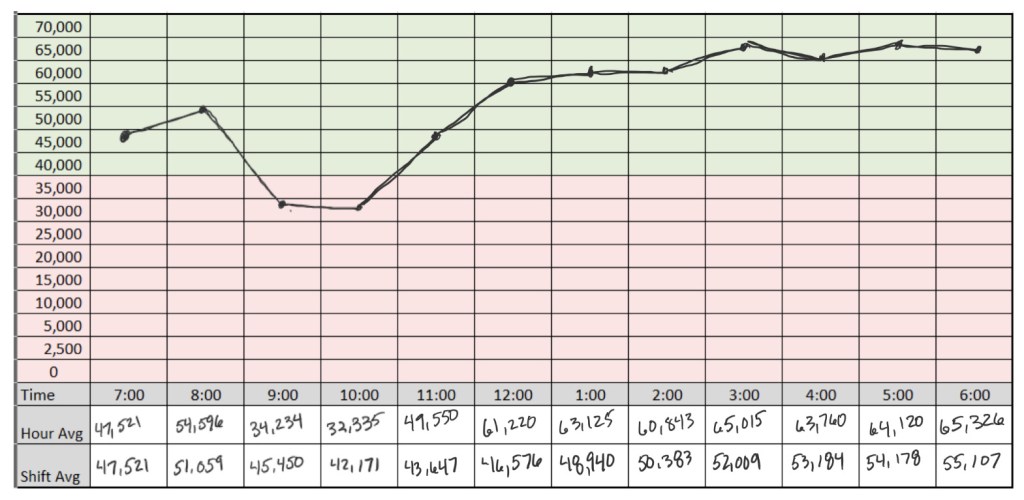
The playbook was completed with a much improved hour by hour and upward moving average.  By the end of the shift the team finished with the fifth highest shift production record as of that date.

Summary

Using and combining the two simple yet effective tools – an SPC chart and production delay log into a Shift Playbook can provide the data and visualization to help your team know what defines winning, understand the current state, and identify roadblocks that are preventing them from winning. 

Kaizen Event Code Of Conduct

The difference between a successful Kaizen event and an unsuccessful one is getting buy-in on these six key items. Downloadable template included.

6 Keys to Frame Your Next Kaizen Event

He came into my office and asked if I could come and help “reign in” the kaizen event that he was leading. I asked what was going on and he replied “we are so off track. I don’t know how we got there or how to get us back. I’m close to just calling it quits if we can’t focus and get our deliverable done in time.”

The team was on a short unscheduled break to let the energy come down. We went to the training center and did a quick review. Looking at the room arrangement, the sticky notes, the writing on the walls, and reviewed the agenda. Things looked in order except for one missing ingredient.

He was not facilitating with a presentation deck but just using an easil and paper with some sticky notes and a black marker. No problem still except two key items were missing.

The first thing I noticed was the absence of a Parking Lot. I asked the facilitator “how are you capturing the out of scope ideas?” He answered “we aren’t. We are talking about everything as it come up.” Parking Lot use is not one that I will address here but it is a gap that contributes to Kaizen event scope creep.

The second and most important thing missing was the Kaizen Code of Conduct; an agreement between the team members that will frame how we act and interact during the event.

The difference between a successful Kaizen event and an unsuccessful one is getting buy-in on these six key items.

I asked him to describe the things that are happening that are contributing to the derailment. See if his response sounds similar to any of your experiences:

  • “The process owners were late and keep leaving the event”
  • “A few of the them are spending more time checking e-mail than participating in the brainstorming. Then when they tune in we have to recap what we just taked about”
  • “Two of the participants have strong personalities and are reacting in ways that is causing others to remain quiet and not participate”
  • “The engineers got up to go get coffee 15 minutes before the coffee order I planned for arrived”
  • “The room is a mess and is going to take me forever to put it back at the end of the day”

Any of those ring a bell? They do with me. So here we will go over setting up your event for success by using a code of conduct around six key items.

Safety

Most Kaizen events will include participants from varied departments in an organization or even people outside the organization who may be unfamiliar with the safety norms. Review key safety items that are specific to your industry. Are there any special hazards that participants should be aware of. At times this may seem like a waste but it is important to remember that often, participants are pulled from their normal work areas so the hazards or evacuation routes may be different than they are accustomed to.

Also review general safety items like locations of first aid items, AED availability, and your organizations procudure for emergency situations, evacuation routes, etc.

Refreshments and Restrooms

Ensure that you provide refreshments prior to the kickoff of the event and communicate that they will be available. Be sure to arrange refills to be available during the schedule breaks. Doing so will provide structure to the breaks.

As an addition to the agenda, let your participants know when lunch will be served (if applicable)

Going along with refreshments, make sure you communicate to participants where the restrooms are.

Time Managment

Gain committment from the group to start on time and end on time – including starting and returning from scheduled break times. This will will keep the flow of the meeting on track. Another key to good time management is to follow the agenda. One caveat is that there may be situations where new data is presented that warrants a pivot from the agenda. This should be the exception and with thte support of the Kaizen sponsor.

Post Event 5S

Recently I walked in to a room to set up for an event. Luckily I was very early because the room had not been put back to its normal condition. After moving tables, chairs, erasing the dry erase boards, and setting up the AV equipment to the standard I could get to the work of preparing for the event.

Don’t be the facilitator that leaves the room a mess. Get committment from the participants to put the room back to standard and properly dispose of waste.

Minimize Distractions

This is probably my biggest pet peave as a facilitator and a participant. Most likely yours as well – people constantly on their phones or laptops doing work unrelated to the event. Getting committment from the team to minimize cell phones, tablets, and laptop use except for value added activity such as taking notes will keep the group engaged and focused.

Be Respectful

Have you ever been part of an event where the discussion got heated? I have. Not fun! This is important to gain buy in at the beginning, especially if there are supervisor or managers interacting with direct or indirect reports. Team members will begin to feel uneasy about participating if leadership or others with strong personalities begin to treat others with disrespect. Establish that everyone’s value and ideas in the room are equal.

Conversations can get heated so give each other permissiong to call timeout if necessary and let the energy subside.

Summary

These six items, shared and committed to by the event participants, will provide parameters that help ensure the success and effectiveness of your next Kaizen event.

Leader Standard Work – PDCA

The art of using LSW as an improvement tool is to be able to read the sheet with your “process” eyes. What this means is not to focus on reds and ask “why didn’t they get done?” What you are looking for as a lean leader are process gaps.

Updating my LSW – reviewing November for lessons learned and applying PDCA to December’s LSW plan

Download a copy of the Excel template used in this post by clicking the link below

Introduction

Leader Standard Work is a leaders visual management system much like a DMS board, Kamishibai, or other lean visual control. The intent is to regularly review (monthly in my case) for opportunities for process improvements (reds) and apply those improvements to the next cycle. Visual Leader Standard Work will reveal two types of gaps: performance and process.

Performance gaps are simple – “was the task completed?” Performance gaps require deeper learning and analysis. In this post it will be assumed that there are no performance gaps to address – only process gaps.

The Review

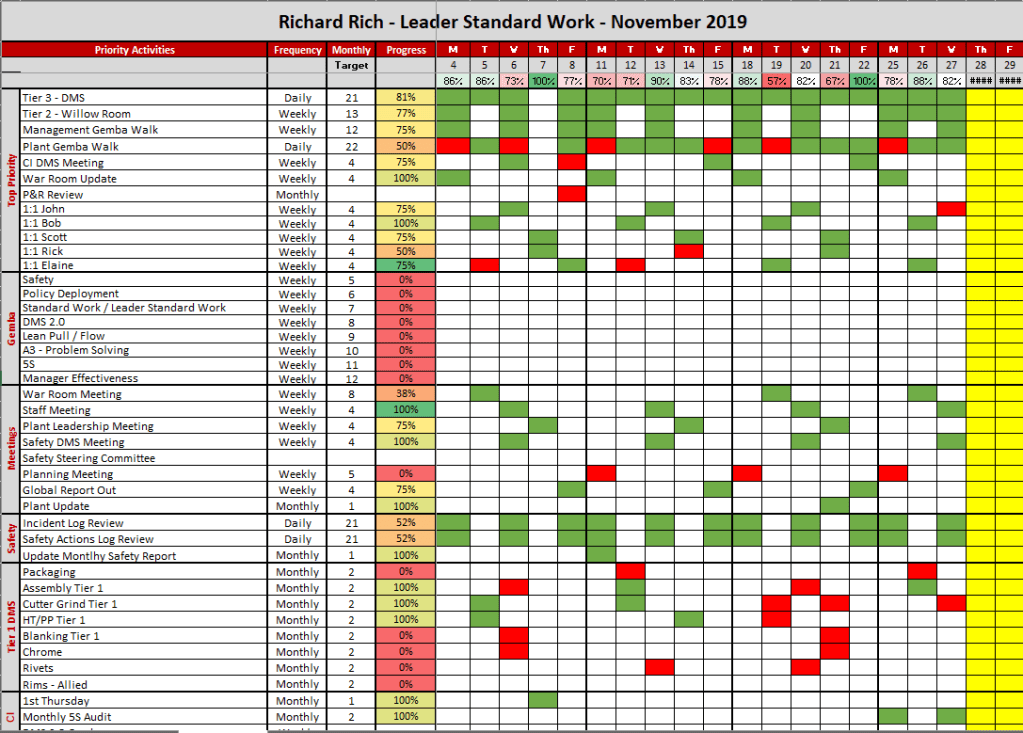
The image below is of my LSW for November.

The art of using LSW as an improvement tool is to be able to read the sheet with your “process” eyes. What this means is not to focus on reds and ask “why didn’t they get done?” What you are looking for as a lean leader are process gaps.

Each behavior or activity of a leader in a lean management system is to sustain process improvements where that same process stability will provide the foundation for further improvements. The focus is on process.

Assuming that there are no performance gaps (the activity was completed as planned) we can move to what constitutes process gaps. Reds will indicate one of two possibilities.

  1. The behavior or activity (audit, Gemba, etc.) is not able to sustain the process. You are unable to really “see” the process in order to measure the expected state verses the current state.
  2. The process is not adequate to sustain the improvement. In this case a red means that you are able to clearly see the expected state and current state but something is not working right – there is a gap, a problem, or a variation.

Lessons Learned

After review it is time to see what you can learn about the process. Analyze the patterns.

In the example above I saw groupings around a particular time of day for attending Tier 1 DMS meetings. The conflict that created the reds were clear and recorded on the paper version that I carry daily. Each one that is missed was due to overlapping requirements at other DMS meetings. It had nothing to do with performance and everything to do with the fact that one cannot be in two places at the same time.

Planned Improvements

The lessons learned from reviewing November’s LSW were used to create December’s.

  1. Space for attendance at the conflicting Tier 1 DMS meetings was created
  2. Communication for Tier 3 DMS attendance plan was provided and aligned to with my manager
  3. Activities planned for early mornings where Tier 1 DMS meetings happen are now planned for later in the day.

Summary

It’s December 1st. Tomorrow is Monday, December 2nd. Is your LSW reviewed and updated? Have you made a plan to sustain the lean improvements?

Take a few moments and reflect on what learned from last month adn make an improvement to be a better lean manager for December

Four Tips for Personal Journaling

We are going to help you be able to sit down and begin a journal that will be yours.  It will fit with the way your mind works.  It will fit your creative style.  In essence – it will be a reflection of who you are! 

Congratulations. You are joining an elite group of people who recognize the importance and value of keeping a personal journal. I have found this to be one of my core personal habits. It is the one thing that keeps me centered psychologically, emotionally, and spiritually. I have found a freedom to express thoughts and feelings that prior to having a journal, I would never entertain thinking about.

My journal is my safe place. There is no judgment in its pages. Just freedom to be me, to express, and to be transparent and vulnerable. It is in this habit of freeing my mind to be open and honest that I have discovered the real person hiding deep down inside.

I hope to help you in your journey and to shorten the time between the choice to pursue the habit of writing and the realization of the value and benefits of the practice. What follows are four tips or words of advice to do just that. I welcome you to this side of the universe! Welcome to the world of journaling.

Tip 1 – Have a Purpose for Your Journal

The first bit of advice is to define your purpose. Why do you want to journal? What was happening at the exact time that made you think “I’d like to begin the habit of journaling?”

There are many possible reasons but they usually center around a few:

  • Capture life moments to share with your family later
  • Personal development
  • Creative outlet
  • Emotional expression
  • Personal healing
  • Professional effectiveness

The benefits of the habit of daily writing and reflection are well known. In fact, one piece of data I recently came across noted that people who journal (write their goals down) are 95% more likely to accomplish them.

The missing piece, however, is the challenge like any new thing that we start, is to stick with it once you’ve started. We will walk through some other tips in this blog the the first and beginning tip is to be clear on your purpose. Know why you want to begin the habit of regular journaling.

Tip 2 – Realize a Value From Journaling

Like anything else, it will be new. This tip is especially important if keeping a journal is something you have always wanted to do and told yourself you would. In fact, it is probable that you may have already tried and started to journal but gave up the habit shortly into the pages. That is okay. I did the same thing.

Unless you receive some type of satisfaction or intangible value from the time and creative energy you put into regular writing, it becomes a chore. No one likes chores – especially me. If, however, you find a value that is greater than the effort, the process of journaling becomes less dependent on rigor and grit and ends up being enjoyable. Avoid the feeling that it is just a regimen at all costs. Every time you start and stop something it becomes harder to start over again. This is because our brains will bring up the memory of our past failed attempts. The negative self-talk may be more than enough to discourage you from doing the one thing to get you out of your rut and take you to the next level.

Tip 1 informed us that we have to know why we are journaling – what do we want out of it. Now we need to get the value out of what we wanted. So in this step, we are going to define the value. It is very simple. Complete the phrase “Journaling will be good for me because _______________.” This is how you will measure value. This will result in the pleasure principle in your mind that will actually release chemicals in your system that tell you “This feels good.” You will experience an increase in the desire not only to journal more frequently but to increase the breadth of content that you are writing about.

Remember this key tip – Your Journaling Has to Add Value.

Tip 3 – Fit Journaling With Your Creative Style.

I am currently on my 6th completed journal (book). Several before them were started but never finished. They included pages with dates or calendars preprinted on them, daily planner items, specific productivity formats, and other help by various publishers. They ranged from the more professional/executive style to the student/homework planning style. They are all good and I don’t mean to downplay the effectiveness of the content, format, or creative genius of the authors.

I found that preset formats were very limiting for my creative mind. This was learned over time. The reason I chose the formatted styles was being a novice, I had no idea what to write. I would sit down, open the cover to the next page and – BLANK! I didn’t know what to say. It was funny because It felt like there were so many thoughts rolling around in my head that they could barely be kept together but when it came time to write there was nothing coming out of my pen.

I hate the feeling of failure or ineffectiveness.  Approaching the journaling process with a preset format was the crutch to get me over the hump.  I would fill in the blanks as best I could by checking off the boxes that the publishing company thought would work for me but at the end of the day, it still didn’t click.  It was like I was filling out someone else’s journal.  It became cumbersome and a chore like we talked about in Tip 2.  Since I didn’t know what to write or how to write it I depended on someone else’s style to dictate how my thoughts would be captured in my journal.

Fortunately, you will not have to experience this. We are going to help you be able to sit down and begin a journal that will be yours. It will fit with the way your mind works. It will fit your creative style. In essence – it will be a reflection of who you are!

For now, avoid journals with formatted pages or content. We need to discover how our minds operate and express thoughts and ideas. You will see that as you free yourself up and let your mind go while holding your pencil or pen, the pages will fill easily as the creative flow is unleashed on blank pages.

The best way to begin is to sit and just record the day and time. Write it down. Next, briefly describe how you feel right now. Don’t mince words. Just be open and honest. Are you tired? Are you frustrated about life or work? Are you experiencing anxiety about your relationships. No need to qualify. Just write it down. Don’t worry if your words are many or few. It doesn’t matter. More words will come as your mind gets used to the newfound freedom.

Next, briefly describe what your day looks like. What is your biggest challenge today? How are you or how will you be prepared to handle it? Write it down.

Lastly, write down a phrase of affirmation. Something that you would say to a friend if they were walking in your shoes right now. Encourage that person. Later on in the evening, you will return to your journal to reflect on the day and receive the words of encouragement.

Tip 4 – Create a Journaling Habit

To get the most value of your personal journal it must become a regular practice. Developing a routine of journaling will, at first, seem like registering for a gym membership right after New Year’s Day. We have already covered the first three elements to take the chore-like feeling out of journaling. Since you will have a purpose (Tip – 1), it will be adding value (Tip – 2), and it will be a reflection of who you are as a person (Tip – 3), The final key is to commit to the routine of journaling. Having covered the first three steps, the time required for the adoption of journaling from a routine to a habit where your mind goes into automatic “journal mode” will be shortened significantly. You will find the time very satisfying and invigorating to the point that you will begin carving out and protecting that time; prioritizing it over old habits that are actually destructive to your personal development. I don’t like coaching people to “develop a habit of …” because habits are a result. If it were that easy to “develop a habit” everyone would be accomplishing everything they started. The process of developing a habit is not easy but it is simple.   The key is repetition.  Just do it. 

A few answers to these questions will help you decide when and where to write in your journal: What is your best time of the day – when are you the most attentive and creative? Do it then. Try the early morning before anyone else is up. If that doesn’t work then try another time. Keep trying until it clicks.

Summary

It seems hard. You don’t know what to write. That’s okay. Everyone starts that way. Just go buy a nice journal. Keep it private. Sit down and write. Use the tips above and see if shortly you come to really enjoy your time and can’t understand why other people don’t journal themselves.

I’d love some feedback on this. What have been your challenges or what have you been experience while you journal?