When mundane, repetitive tasks are automated, supervisors are no longer bogged down by the minutiae of day-to-day operations. Instead, they can redirect their focus towards higher-level strategic activities and, most importantly, their teams.
Finding ways to improve efficiency and productivity is essential. I’m currently automating some quality checks for my supervisors, a move that promises to streamline their workload significantly. The reduction of paperwork and non-value-added activities frees them up to focus on what truly matters: problem-solving and team development. This shift is not only beneficial for efficiency but also for building a more engaged and motivated workforce.
The Power of Standardization in Automation
Standardization in automation refers to the establishment of consistent, repeatable processes that can be efficiently managed by automated systems. This approach minimizes variability, reduces errors, and ensures high-quality outcomes. As highlighted in a Harvard Business Review article, “Standardizing processes is a crucial step in leveraging the full potential of automation. It creates a stable foundation upon which innovative and creative work can thrive.”
Liberating Supervisors to Lead and Inspire
When mundane, repetitive tasks are automated, supervisors are no longer bogged down by the minutiae of day-to-day operations. Instead, they can redirect their focus towards higher-level strategic activities and, most importantly, their teams. Here are some ways this shift can positively impact an organization:
Enhanced Employee Engagement: Supervisors who have the time to engage with their teams can foster stronger relationships and create a more inclusive work environment. By being present and available, they can better understand their employees’ needs, aspirations, and challenges, leading to more personalized and effective leadership. According to Harvard Business Review, “Automation of administrative tasks frees managers to focus on coaching and development, significantly boosting team engagement.”
Building a Positive Culture: A strong organizational culture is built on trust, communication, and shared values. When supervisors are not tied down by administrative tasks, they can invest time in activities that promote these elements, such as team-building exercises, open forums, and one-on-one meetings. As noted by Harvard Business Review, “Culture-building activities are essential in both traditional and hybrid work environments, fostering a sense of belonging and shared purpose.”
Encouraging Innovation: With the administrative load lightened, supervisors can focus on fostering a culture of innovation. They can encourage their teams to think creatively, experiment with new ideas, and take calculated risks. This environment not only motivates employees but also drives the organization forward. “When managers are freed from routine tasks, they can better support innovation and creativity within their teams,” emphasizes a Harvard Business Review article.
Personal and Professional Development: Supervisors who can dedicate time to mentoring and coaching can significantly impact their team’s growth. By providing regular feedback, setting clear goals, and supporting professional development, they can help their employees reach their full potential. As stated in Harvard Business Review, “Investing in the professional development of employees not only enhances their skills but also boosts morale and job satisfaction.”
Real-World Examples
Many organizations have seen the benefits of this approach. For instance, Toyota’s adoption of standardized automation processes in their manufacturing has allowed supervisors to focus more on their teams. This shift has been integral to their renowned culture of continuous improvement and employee development.
Another example is the use of automated tools in the tech industry. Companies like Google and Microsoft use automation to handle repetitive coding and testing tasks. This allows supervisors and senior engineers to focus on innovative projects and mentoring junior staff, fostering a collaborative and growth-oriented environment.
Conclusion: The Human Side of Automation
Automation and standardization are often viewed through a lens of efficiency and productivity. However, their true power lies in their ability to free up human potential. By automating routine tasks, supervisors can focus on what truly matters—people. They can build stronger relationships, foster a positive culture, and drive innovation, ultimately leading to a more engaged and motivated workforce.
As we continue to embrace automation, it’s crucial to remember that its greatest benefit is not just in the tasks it can perform, but in the time and space it creates for human connection and growth. In the end, it’s this balance of technology and humanity that will drive organizations towards sustainable success.
When we create or update processes and they are not fully understood by the people doing the work, they will find ways to get the work done based on their own experiences. Evidence of this is when you try to train someone with different people and the trainer remarks “we don’t do it that way on our shift.” LOL. This is probably heard more often than not.
It must be understood by those doing the work
It was Friday night November 5th. Several planning sessions were held the few days prior showing some statistics, trends, and other data to create a plan to optimize the weekend production run for a national customer of ours. About 11:30 PM I received the phone call from a seemingly nervous Batching Technician.
We were planning on transitioning from multiple pallets of #50 bags, very laborsome, to #2,000 super sacks where most of the labor would be done by a machine, except for one hiccup. The technician didn’t understand the process of how to use it.
But we were not ready for that yet. We had an internal agreement to delay the implementation due to some previous issues. Now, however, we were possibly being forced to move forward with the process.
The SOP Dilemma
I read through the SOP. It didn’t seem that difficult but then again, I will not be in the plant at 1:15 AM when they attempt to load the ingredient. I am not a fan when it comes to SOP’s. I align and agree that they serve a purpose in that they can document a process but too often they are miscategorized as a “training tool.” Fully support their use for ISO Standards and audits, etc. But when it comes to skill building in a competency matrix type of paradigm, their use is more for a general introduction and not in skill building.
Breaking Rule #2
If a process isn’t fully understood, it will result in individuals developing their own understanding of the process based on “educated guesses” and “trial and error.
Without a full understanding of this mixing process, we were at risk. We aren’t creating small batches or parts. We are mixing batches of liquids up to 15,000 gallons. To make a mistake would require scrapping an entire production order and facing a possible claim. This is unacceptable. But this is true of any industry or process.
When we create or update processes and they are not fully understood by the people doing the work, they will find ways to get the work done based on their own experiences. Evidence of this is when you try to train someone with different people and the trainer remarks “we don’t do it that way on our shift.” LOL. This is probably heard more often than not.
Back to our process. A mechanical delay caused just enough of a slow down that when we got to the point of needing to start this bulk mixing process, the early morning dayshift leader had already arrived. He had a lot of experience and was familiar with it. Needless to say, the batch went off without a hitch – or mistake! We focused on getting each team member familiar and fully understanding how to use the bulk mixer for supersacks.
The difference between a successful Kaizen event and an unsuccessful one is getting buy-in on these six key items. Downloadable template included.
6 Keys to Frame Your Next Kaizen Event
He came into my office and asked if I could come and help “reign in” the kaizen event that he was leading. I asked what was going on and he replied “we are so off track. I don’t know how we got there or how to get us back. I’m close to just calling it quits if we can’t focus and get our deliverable done in time.”
The team was on a short unscheduled break to let the energy come down. We went to the training center and did a quick review. Looking at the room arrangement, the sticky notes, the writing on the walls, and reviewed the agenda. Things looked in order except for one missing ingredient.
He was not facilitating with a presentation deck but just using an easil and paper with some sticky notes and a black marker. No problem still except two key items were missing.
The first thing I noticed was the absence of a Parking Lot. I asked the facilitator “how are you capturing the out of scope ideas?” He answered “we aren’t. We are talking about everything as it come up.” Parking Lot use is not one that I will address here but it is a gap that contributes to Kaizen event scope creep.
The second and most important thing missing was the Kaizen Code of Conduct; an agreement between the team members that will frame how we act and interact during the event.
The difference between a successful Kaizen event and an unsuccessful one is getting buy-in on these six key items.
I asked him to describe the things that are happening that are contributing to the derailment. See if his response sounds similar to any of your experiences:
“The process owners were late and keep leaving the event”
“A few of the them are spending more time checking e-mail than participating in the brainstorming. Then when they tune in we have to recap what we just taked about”
“Two of the participants have strong personalities and are reacting in ways that is causing others to remain quiet and not participate”
“The engineers got up to go get coffee 15 minutes before the coffee order I planned for arrived”
“The room is a mess and is going to take me forever to put it back at the end of the day”
Any of those ring a bell? They do with me. So here we will go over setting up your event for success by using a code of conduct around six key items.
Most Kaizen events will include participants from varied departments in an organization or even people outside the organization who may be unfamiliar with the safety norms. Review key safety items that are specific to your industry. Are there any special hazards that participants should be aware of. At times this may seem like a waste but it is important to remember that often, participants are pulled from their normal work areas so the hazards or evacuation routes may be different than they are accustomed to.
Also review general safety items like locations of first aid items, AED availability, and your organizations procudure for emergency situations, evacuation routes, etc.
Refreshments and Restrooms
Ensure that you provide refreshments prior to the kickoff of the event and communicate that they will be available. Be sure to arrange refills to be available during the schedule breaks. Doing so will provide structure to the breaks.
As an addition to the agenda, let your participants know when lunch will be served (if applicable)
Going along with refreshments, make sure you communicate to participants where the restrooms are.
Time Managment
Gain committment from the group to start on time and end on time – including starting and returning from scheduled break times. This will will keep the flow of the meeting on track. Another key to good time management is to follow the agenda. One caveat is that there may be situations where new data is presented that warrants a pivot from the agenda. This should be the exception and with thte support of the Kaizen sponsor.
Post Event 5S
Recently I walked in to a room to set up for an event. Luckily I was very early because the room had not been put back to its normal condition. After moving tables, chairs, erasing the dry erase boards, and setting up the AV equipment to the standard I could get to the work of preparing for the event.
Don’t be the facilitator that leaves the room a mess. Get committment from the participants to put the room back to standard and properly dispose of waste.
Minimize Distractions
This is probably my biggest pet peave as a facilitator and a participant. Most likely yours as well – people constantly on their phones or laptops doing work unrelated to the event. Getting committment from the team to minimize cell phones, tablets, and laptop use except for value added activity such as taking notes will keep the group engaged and focused.
Be Respectful
Have you ever been part of an event where the discussion got heated? I have. Not fun! This is important to gain buy in at the beginning, especially if there are supervisor or managers interacting with direct or indirect reports. Team members will begin to feel uneasy about participating if leadership or others with strong personalities begin to treat others with disrespect. Establish that everyone’s value and ideas in the room are equal.
Conversations can get heated so give each other permissiong to call timeout if necessary and let the energy subside.
Summary
These six items, shared and committed to by the event participants, will provide parameters that help ensure the success and effectiveness of your next Kaizen event.
Answering these critical 7 Questions will enable you to increase your meeting effectiveness, increase the value proposition, and reduce the time you spend on non-value activities.
Best Practices for Meeting Leaders
7 Questions to Answer Before You Plan Your Next Meeting
1. Is It Necessary?
Have you ever been a participant in a meeting and wondered to yourself “why am I here?” Or said, “this is such a waste of time.” Often times, we are subject to habitual meeting scheduling. We have meetings just because we’ve always had meetings. Regularly scheduled meetings may be value-added. Most, in my experience, are not, however. A good question to qualify the need for a single or recurring meeting is by asking “Is there any other way to exchange the information?” This could be via email, a corporate discussion board, or a simple memo. Beware of meetings that exist solely for the exchange of information. If there is any way to get or give the information then do it that way. Save yourself and others from the time-wasting.
2. What Is The Purpose?
Consider this idea before determining whether you should plan a meeting. Every meeting is a transaction; a value proposition. People are exchanging their time for your meeting content. Though you may have stated expectations of engagement with group Codes of Conduct or meeting charters, we have all seen the gradual decline of engagement where cell phones are checked more frequently or the tapping of laptop keyboards can be heard around the table by people pretending to be present but are focused on more pressing issues. When people receive little to no value, they check out. You can force people to turn off their communication devices or close laptops but you cannot force engagement. So before you send the meeting invitation, make sure you have a specific goal to be achieved by the adjournment.
A big help is to prep the participants for your goal. Will there be a vote where consensus will decide or are you facing a tough decision and seeking the input value form the team members? Define the purpose, set the goal, and prep the team before they meet.
3. Have You Invited The Right People?
This question is related to number 1 where the necessity for a meeting was addressed. While you are evaluating who or how many people to invite a general rule to keep in mind is “less is more.” To be effective, a meeting group should be limited to around 7 – 12 people. You may consider having more but only if there is an explicit value or contribution by the additional team members. Any more than that and you can literally feel the stalling effect as too many voices and too many opinions steer the focus away from the meeting purpose. Remember, value is the important factor not diversity of inputs. During your meeting planning process ask yourself “how valuable is this person’s contribution to the meeting purpose?”
For clarification, it is not meant to measure the value of someone’s contribution to the organization. It is about being respectful. You are respecting the value of their time to be spent on other important things instead of wasting their time in your meeting.
Develop your traditional attendee list and then filter it through the lens of value contribution. If they only need the information shared during the meeting they can be added to the meeting minutes distribution list mentioned later in question seven.
4. Are You Prepared?
Now we break from the things that make meetings only mildly frustrating to those things that cause them to be labeled as “cruel and unusual punishment.” I am unable to quantify this but a casual recollection of all the meetings I have participated in, around 80 percent should not have been called meetings but working sessions.
A working session disguised as a meeting is where the meeting chair or facilitator has called a meeting to produce a deliverable for which they are accountable. During the meeting time, ideas are exchanged or discussed. Someone may even Google a topic for clarification. The meeting organizer fills out the spreadsheet or report items on the screen with everyone watching. The meeting is over and the only value that can be ascribed is that the organizer’s report has been completed. During that process though, everyone else has heard the sucking sound as their valuable time has been stolen as a consequence of the organizer’s lack of execution or preparation.
If you require a working session, hold a working session but be clear. It is not a meeting. If you do not clarify, you will undoubtedly waste someone else’s time. Here are the minimum requirements that need to be part of your regular meeting structure to ensure that you are prepared and can capitalize on the value contribution of those attending.
Pre-reads – send them out early and give them plenty of time to get through the material. Opinions and feedback can be prepared and even forwarded prior to the meeting increasing the meeting efficiency.
Agenda – Only items that add value and contribute to the meeting purpose should be added. Anything else will reduce the value proposition for each member’s time. State them clearly and completely. Format your agenda items in a way that will ensure your ability to accomplish your purpose within the established meeting time frame. This should include a “What,” a “Who,” and a “How Long.” Having an agenda allows people to come to the meeting prepared and lets them know the time frame they will be allowed. Here is the same agenda that I used recently and made the meeting very quick and very efficient. Example:
“Fixed Cost Improvement Recommendation – John Doe – 10 min.”
Attendance Roster – Required and optional
Meeting Expectations
Deliverables
Open Actions
Escalation Items
Parking Lot
5. Do you have a way of handling off-topic issues? (Parking Lot)
Nothing can derail a meeting quicker than issues that are truly important but are out of scope for this particular meeting. There are a few notable characters that I am sure everyone reading this post have met and may still be sitting across the table from.
Terrorist Tony
The first character is who I like to call Terrorist Tony. This person seems unable to get a forum to discuss issues that they alone are zealous about so they choose to bring them up whenever they can get an audience – in your meeting. Though not directly related, they feel that because it is important, it needs to take up valuable time in your meeting.
Distracted Dave
The second character is “Distracted Dave.” He allows his mind to wander while he speaks covering every possible rabbit trail and somehow never ends up at the solution that prompted his input.
Politician Patty
A third character is Politician Patty. She just loves to hear herself talking – regardless of the value of what is being said. She often reiterates what others have said, rarely offers new insights and never creates value. Politician Patty will even give voice to Terrorist Tony’s important issue just so she can seem to care.
Back to the Agenda
A danger in trying to steer towards the agenda is the public de-marginalizing or devaluing the people who are raising the issues. An effective way to handle these important but off-topic issues is the Parking Lot. You can assign value to the person, acknowledge the importance of the issue, and stay on topic by immediately recording the issue to the Parking Lot. Remember though, it is not your responsibility to resolve the issue. You are just acknowledging the potential value.
6. Will there be any action items?
If there are no resulting action items at the meeting’s conclusion you need to question its value. All “meetings” should result in action items. Work sessions are different, so are brainstorming sessions. With meetings, however, problems should be addressed which require further action. Make sure you do the five following things (S.M.A.R.T.) to keep an active Action Register:
Describe the action in detail including what the end state or deliverable looks like
Assign an owner. This person is responsible for the completion of the deliverable
Establish a due date
Describe the escalation process. If the completion date is missed – what is the next step?
Follow up at the next meeting. Review the Action Register at each meeting to ensure everything is on target and no new issues have presented
7. How soon will you send out Minutes?
Sending meeting minutes is critical to your meeting effectiveness. Providing a record of issues, discussion, and resolution allows you to trim down your member list as mentioned in question one. It also provides an opportunity for clarification. People can read minutes and reframe their understanding making an addendum to the minutes at the next meeting. Another value is that owners can review action items that were assigned to them.
Summary
Answering these critical 7 Questions will enable you to increase your meeting effectiveness, increase the value proposition, and reduce the time you spend on non-value activities. The 7 Questions reframed as 7 Best Practices for Meetings are:
Evaluate the need
Define the purpose
Invite the right people
Be prepared
Stick to the agenda
Record action items
Publish meeting minutes
Resources
Dieken, C. (n.d.). Talk Less, Say More: Three Habits to Influence Others and Make things Happen: Kindle Edition. Wiley
Elliot, B. (n.d.). MAKE YOUR POINT!: SPEAK CLEARLY AND CONCISELY ANYPLACE, ANYTIME: Kindle Edition. AuthorHouse
Granville, T. (n.d.). The New Articulate Executive: Look, Act and Sound Like a Leader: Kindle Edition. McGraw-Hill Education
Lencioni, P. (n.d.). Overcoming the Five Dysfunctions of a Team: A Field Guide for Leaders, Managers, and Facilitators (J-B Lencioni Series): Kindle Edition. Wiley
Wortmann, J. (n.d.). Mastering Communication at Work: How to Lead, Manage, and Influence. Kindle Edition. McGraw-Hill Education
Answering these critical 7 Questions will enable you to increase your meeting effectiveness, increase the value proposition, and reduce the time you spend on non-value activities.
Best Practices for Meeting Participants
7 Questions to Answer Before You Attend Your Next Meeting
1. Do I Really Need to Be There?
I have yet to meet someone who shared that they were so bored at work due to their lack of to-dos. Most often that list grows faster than we can execute leaving us feeling frustrated and constantly behind schedule. I recall a time where I carved out a two-hour time slot to catch up on some project deliverables at the end of the week. I wouldn’t have been officially “caught up” with my task list but checking those deliverables of my list would have significantly reduced the feeling of being behind. At 8:00 AM that morning, you can probably guess what happened. My calendar pop up came on the screen with a meeting invitation that was marked “required.” You can hear the gas leaking from my productivity bubble.
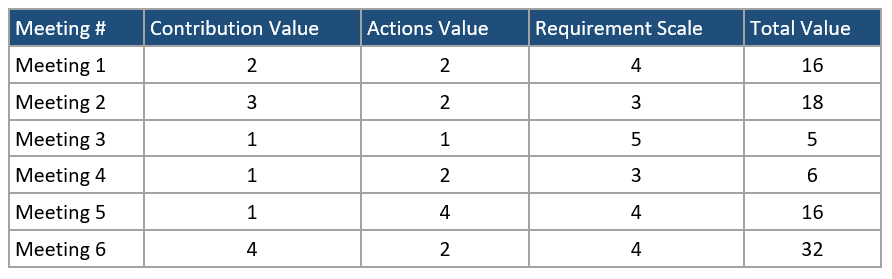
Take a moment to map out every meeting you attend through the month similar to fig 1 below. Then, using a scale of 1-5, list the value of your contribution and the value of the actions, and the level of requirement to attend. Multiply across to get to the total value proposition of that meeting.
Figure 1 – Meeting Matrix
You are looking for two key numbers. The first is key meetings with low action value (column 3). It is not a rule but generally, if you can walk out of a meeting with no new action items, it is very likely that you could receive the information in a different format than a meeting. The other key number is the high requirement or expectation scale with a low value. Take Meeting 3 for example. You provide a little contribution. You receive no new action items. And you are expected to be there every time. Your attendance at this meeting needs to be evaluated.
2. What Value Do I Bring to the Table?
Depending on your position in your organization, you may or may not have the freedom to click the “Decline” button on calendar requests. But the least you can do is have an internal conversation and estimate what value proposition you provide by sitting at the table. Is it a hard value or a perceived value? A hard value is one in which you regularly contribute verbally or provide inputs that add to the meeting purpose. Perceived value is where you are deemed important by your colleagues and they feel like you just need to be there. If your attendance is required make sure you bring value to the meeting. There is no better testimony to your lack of value proposition than rarely contributing anything to meetings or rarely receiving action items as a result. The key is to find out what matters to your manager or the meeting facilitator.
Review the minutes of your most recent meetings attended and look for the value you have added or the actions you have received. If neither exists then consider a discussion with your manager or the meeting facilitator about being more selective about your required attendance.
3. Are My Previous Action ItemsCompleted & Communicated?
Let’s clear the confusion right away. Action items are performance expectations. Get them done by the target established in the meeting and communicate to the team that they are completed. So much time is wasted reviewing incomplete action items.
If, by chance, you are unable to complete action items assigned to you communicate that to the team prior to the meeting. But don’t just say “I didn’t get this done.” Include an updated plan and the expected completion date for the team. This will help your section of the meeting proceed without interruption.
4. Am I Prepared?
I am going to use the phrase “this was funny” but it is anything but funny. I was prepping for a meeting and needed to print out some data packets to share during my portion. There was no reason to believe that anything would be different this time.
I pushed “Print” just before leaving my office with my laptop in hand. When I went to the printer there was an error message. Now I am panicking. I knew I should have given myself more time to prepare just in case something like this happened. In fact, I had considered printing and preparing the day before just to be sure. Murphy’s Law bit me hard. Lesson learned.
Prepare early and give yourself enough time in case the unfortunate circumstance delays getting all you need for the meeting.
5. Have I reviewed the agenda? Be prepared to add value to the issue.
Having an agenda before a meeting was discussed in Part I – a previous post. Here we will assume that the meeting organizer is following best practices by publishing an agenda ahead of time.
Reviewing the agenda helps you gather data prior to the meeting so that if or when you are called on for some input you will have the data to back up what you say. Another benefit is that a review of the agenda will help you frame your participation knowing when you can stay silent and avoid non-value added inputs to the conversations.
6. Do I have any related issues that were not on the published agenda?
This situation usually happens with recurring meetings. You have an issue that needs to be addressed. You submit it to the organizer. Then you see that it is not included on the agenda. Better to ask the organizer to include the issue prior to the meeting and receive feedback on why it will not make the agenda than to risk the awkwardness during the meeting.
7. Do I have the bandwidth to accept action items?
Have you been here as well? Your schedule is already overloaded. You barely had time to make this meeting. By then end, you have been assigned a couple of tasks with no capacity in your schedule to add any more.
One thing to consider is whether you can realistically contribute to the execution of the meeting team’s actions list. If you barely have time to attend, how will you have time to add more actions? Take this into consideration as you evaluate whether you should or should not attend a particular meeting.
Summary
Answering these critical 7 Questions will enable you to increase your meeting effectiveness, increase the value proposition, and reduce the time you spend on non-value activities. The 7 Questions reframed as 7 Best Practices for Meetings are:
Do I Need to Be There
Can I Add Value
Are My Actions Completed
Am I Prepared
Have I Reviewed the Agenda
Do I Have Other Issues Not On the Agenda
Can I Realistically Accept Action Items
Resources
Dieken, C. (n.d.). Talk Less, Say More: Three Habits to Influence Others and Make things Happen: Kindle Edition. Wiley
Elliot, B. (n.d.). MAKE YOUR POINT!: SPEAK CLEARLY AND CONCISELY ANYPLACE, ANYTIME: Kindle Edition. AuthorHouse
Granville, T. (n.d.). The New Articulate Executive: Look, Act and Sound Like a Leader: Kindle Edition. McGraw-Hill Education
Lencioni, P. (n.d.). Overcoming the Five Dysfunctions of a Team: A Field Guide for Leaders, Managers, and Facilitators (J-B Lencioni Series): Kindle Edition. Wiley
Wortmann, J. (n.d.). Mastering Communication at Work: How to Lead, Manage, and Influence. Kindle Edition. McGraw-Hill Education








 Welcome to The Learning Leader