
5 Proven Steps for Effectively Solving Problems

Structured problem-solving is a valuable tool for effectively identifying and addressing problems. It allows for a logical and systematic approach that can help to ensure that the best solution is chosen and implemented. However, there are several factors that can prevent people from using this process, and it is important to be aware of these obstacles in order to overcome them and make the most of this problem-solving method.


Structured problem-solving is a systematic process for identifying and resolving problems. It involves defining the problem, generating potential solutions, evaluating those solutions, choosing the best one, and implementing and testing it. However, there are several reasons why people may not use this approach, including a lack of time, a lack of understanding, personal biases, group dynamics, and resistance to change.

The 5 Steps:

  1. Define the problem clearly and accurately
  2. Generate potential solutions
  3. Evaluate the potential solutions
  4. Choose the best solution
  5. Implement and test the solution

Clarification of Each Strategy

  1. Defining the problem clearly and accurately is the first step in effective problem-solving. This involves understanding the root cause of the problem and identifying any underlying issues that may be contributing to it.
  2. Generating potential solutions involves coming up with as many ideas as possible for addressing the problem. This can be done through brainstorming sessions with a team or individually.
  3. Evaluating the potential solutions involves analyzing each solution and considering its pros and cons. This helps to determine which solution is the most viable.
  4. Choosing the best solution involves selecting the solution that is most likely to effectively address the problem and meet the desired outcomes.
  5. Implementing and testing the solution involves putting the chosen solution into action and evaluating its effectiveness. This may involve making adjustments or trying a different solution if the initial one does not produce the desired results.

Resistance to Structured Problem-Solving

There are several reasons why people may not use structured problem-solving:

  1. Lack of time: Sometimes, people may feel that they do not have the time to follow a structured problem-solving process. They may feel pressure to come up with a solution quickly and may skip steps in order to do so.
  2. Lack of understanding: Some people may not understand the value of structured problem-solving or may not know how to use the process effectively.
  3. Personal biases: People may have their own biases or preconceived notions that prevent them from considering all possible solutions or evaluating them objectively.
  4. Group dynamics: In a group setting, there may be social pressures or dynamics at play that prevent people from fully participating in the problem-solving process.
  5. Resistance to change: Some people may be resistant to trying new approaches or may be comfortable with their existing ways of problem-solving, even if they are not the most effective.

The Fishbone Diagram

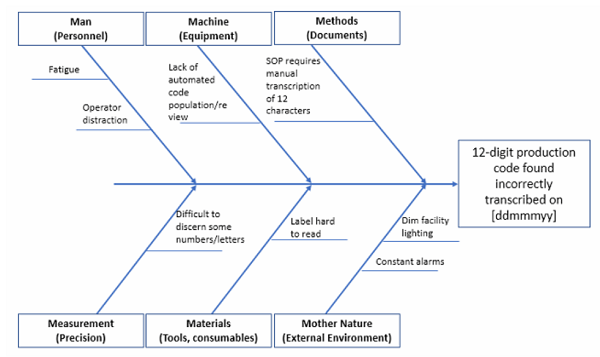
To assist in overcoming the resistance to using structured problem-solving, an Ishikawa diagram, also known as a “cause and effect diagram” or a “fishbone diagram,” is a tool used to identify and analyze the root causes of a problem. It is named after its creator, Dr. Kaoru Ishikawa, who developed the method in the 1950s as a way to improve quality control in manufacturing. Today, it is widely used in a variety of industries, including healthcare, finance, and engineering, to help teams understand and solve problems more effectively.

To create an Ishikawa diagram, start by identifying the problem you are trying to solve and writing it at the head of the diagram. Then, draw a horizontal line branching off from the head of the diagram and label it with one of the six main categories of causes: people, methods, machines, materials, measurement, and environment. These categories represent the most common sources of problems and are meant to be used as a starting point for brainstorming.

Next, draw additional lines branching off from each of the main categories, and label them with specific causes that could be contributing to the problem. It is important to be as specific and detailed as possible, as this will help you identify the root cause of the problem more easily.

Once you have identified all of the potential causes, you can begin analyzing the data and looking for patterns or trends. This may involve collecting additional data, such as measurements or observations, or conducting experiments to test your hypotheses.

One of the key benefits of using an Ishikawa diagram is that it helps teams visualize the relationships between different causes and their potential impact on the problem. This can make it easier to identify the root cause of the problem, rather than just addressing the symptoms.

An Ishikawa diagram is a powerful tool for root cause analysis that can help teams understand and solve problems more effectively. By identifying the main categories of causes and brainstorming specific contributing factors, teams can use this method to identify the root cause of a problem and implement effective solutions.

Conclusion:

In conclusion, structured problem-solving is a valuable tool for effectively identifying and addressing problems. It allows for a logical and systematic approach that can help to ensure that the best solution is chosen and implemented. However, there are several factors that can prevent people from using this process, and it is important to be aware of these obstacles in order to overcome them and make the most of this problem-solving method.

4 Rules of Process: Rule #1

“This approach is not unilateral however. It is necessary to play catch ball with those who will be doing the work. This will ensure they buy in to the process but it is up to the leader to define the parameters to make sure no effort is wasted.”

Rule #1 – It must be defined by those planning the work

This is the foundation of good process.  In my experience with developing Standard Work and Leader Standard work, there have been variations on how to approach creating a process that is stable, repeatable, and effective to where the process produces the planned results.

One approach is very “hands off” where leaders delegate the formation and implementation to those actually doing the work.  At first this sounds like an empowering approach but in reality it almost never works for standardization.

It usually occurs in actions and activities that are not aligned with the higher level strategy; a lot of effort and actions but little value or contribution the KPI or other metrics.

A better way is to, as the leader, own the definition of the process by answering one or more of the following questions:

  1. What problem are we trying to solve?
  2. What value is it trying to add?
  3. What outcome is intended?
  4. How will completion directly impact the target?

This approach is not unilateral however.  It is necessary to play catch ball with those who will be doing the work.  This will ensure they buy in to the process but it is up to the leader to define the parameters to make sure no effort is wasted.

Breaking Rule #1

If a process is not clearly defined, it will be up to the individual worker to know how to get the job done; this means that the process will be done differently by different people

A short time ago it became necessary to be present on the production floor for the night shift.  Though a significant interruption to my normal schedule I welcomed the opportunity to observe a different shift / team perform the same activities.

It was interesting to talk to the operator through the changeovers and startups.  They were aligned with the end goal – minimizing downtime during changeovers.  The difference was how to get there.

The night shift operator did many of the same tasks , however, in a different order.  But, they also did some of the steps differently.  The data would support, less efficiently and effectively.

Fortunately the operator was open to some input and best practice sharing.  To top it off, the next hour was the second highest production rate ever recorded since our startup 1.5 years ago.

Defining the process for the operator enable them to run at a rate they had never run before.

Kudos to the team and kudos to the 1st rule of process – It must be defined by those planning the work.

Meetings Aren’t Bad, Bad Meetings Are Bad – Part I

Answering these critical 7 Questions will enable you to increase your meeting effectiveness, increase the value proposition, and reduce the time you spend on non-value activities.

Best Practices for Meeting Leaders

7 Questions to Answer Before You Plan Your Next Meeting

1. Is It Necessary?

Have you ever been a participant in a meeting and wondered to yourself “why am I here?” Or said, “this is such a waste of time.” Often times, we are subject to habitual meeting scheduling. We have meetings just because we’ve always had meetings. Regularly scheduled meetings may be value-added. Most, in my experience, are not, however. A good question to qualify the need for a single or recurring meeting is by asking “Is there any other way to exchange the information?” This could be via email, a corporate discussion board, or a simple memo. Beware of meetings that exist solely for the exchange of information. If there is any way to get or give the information then do it that way. Save yourself and others from the time-wasting.

2. What Is The Purpose?

Consider this idea before determining whether you should plan a meeting. Every meeting is a transaction; a value proposition. People are exchanging their time for your meeting content. Though you may have stated expectations of engagement with group Codes of Conduct or meeting charters, we have all seen the gradual decline of engagement where cell phones are checked more frequently or the tapping of laptop keyboards can be heard around the table by people pretending to be present but are focused on more pressing issues. When people receive little to no value, they check out. You can force people to turn off their communication devices or close laptops but you cannot force engagement. So before you send the meeting invitation, make sure you have a specific goal to be achieved by the adjournment.

A big help is to prep the participants for your goal. Will there be a vote where consensus will decide or are you facing a tough decision and seeking the input value form the team members? Define the purpose, set the goal, and prep the team before they meet.

3. Have You Invited The Right People?

This question is related to number 1 where the necessity for a meeting was addressed. While you are evaluating who or how many people to invite a general rule to keep in mind is “less is more.” To be effective, a meeting group should be limited to around 7 – 12 people. You may consider having more but only if there is an explicit value or contribution by the additional team members. Any more than that and you can literally feel the stalling effect as too many voices and too many opinions steer the focus away from the meeting purpose. Remember, value is the important factor not diversity of inputs. During your meeting planning process ask yourself “how valuable is this person’s contribution to the meeting purpose?”

For clarification, it is not meant to measure the value of someone’s contribution to the organization. It is about being respectful. You are respecting the value of their time to be spent on other important things instead of wasting their time in your meeting.

Develop your traditional attendee list and then filter it through the lens of value contribution. If they only need the information shared during the meeting they can be added to the meeting minutes distribution list mentioned later in question seven.

4. Are You Prepared?

Now we break from the things that make meetings only mildly frustrating to those things that cause them to be labeled as “cruel and unusual punishment.” I am unable to quantify this but a casual recollection of all the meetings I have participated in, around 80 percent should not have been called meetings but working sessions.

A working session disguised as a meeting is where the meeting chair or facilitator has called a meeting to produce a deliverable for which they are accountable. During the meeting time, ideas are exchanged or discussed. Someone may even Google a topic for clarification. The meeting organizer fills out the spreadsheet or report items on the screen with everyone watching. The meeting is over and the only value that can be ascribed is that the organizer’s report has been completed. During that process though, everyone else has heard the sucking sound as their valuable time has been stolen as a consequence of the organizer’s lack of execution or preparation.

If you require a working session, hold a working session but be clear. It is not a meeting. If you do not clarify, you will undoubtedly waste someone else’s time. Here are the minimum requirements that need to be part of your regular meeting structure to ensure that you are prepared and can capitalize on the value contribution of those attending.

  • Pre-reads – send them out early and give them plenty of time to get through the material. Opinions and feedback can be prepared and even forwarded prior to the meeting increasing the meeting efficiency.
  • Agenda – Only items that add value and contribute to the meeting purpose should be added. Anything else will reduce the value proposition for each member’s time. State them clearly and completely. Format your agenda items in a way that will ensure your ability to accomplish your purpose within the established meeting time frame. This should include a “What,” a “Who,” and a “How Long.” Having an agenda allows people to come to the meeting prepared and lets them know the time frame they will be allowed. Here is the same agenda that I used recently and made the meeting very quick and very efficient. Example:
    • “Fixed Cost Improvement Recommendation – John Doe – 10 min.”
  • Attendance Roster – Required and optional
  • Meeting Expectations
  • Deliverables
  • Open Actions
  • Escalation Items
  • Parking Lot

5. Do you have a way of handling off-topic issues? (Parking Lot)

Nothing can derail a meeting quicker than issues that are truly important but are out of scope for this particular meeting. There are a few notable characters that I am sure everyone reading this post have met and may still be sitting across the table from.

Terrorist Tony

The first character is who I like to call Terrorist Tony. This person seems unable to get a forum to discuss issues that they alone are zealous about so they choose to bring them up whenever they can get an audience – in your meeting. Though not directly related, they feel that because it is important, it needs to take up valuable time in your meeting.

Distracted Dave

The second character is “Distracted Dave.” He allows his mind to wander while he speaks covering every possible rabbit trail and somehow never ends up at the solution that prompted his input.

Politician Patty

A third character is Politician Patty. She just loves to hear herself talking – regardless of the value of what is being said. She often reiterates what others have said, rarely offers new insights and never creates value. Politician Patty will even give voice to Terrorist Tony’s important issue just so she can seem to care.

Back to the Agenda

A danger in trying to steer towards the agenda is the public de-marginalizing or devaluing the people who are raising the issues. An effective way to handle these important but off-topic issues is the Parking Lot. You can assign value to the person, acknowledge the importance of the issue, and stay on topic by immediately recording the issue to the Parking Lot. Remember though, it is not your responsibility to resolve the issue. You are just acknowledging the potential value.

6. Will there be any action items?

If there are no resulting action items at the meeting’s conclusion you need to question its value. All “meetings” should result in action items. Work sessions are different, so are brainstorming sessions. With meetings, however, problems should be addressed which require further action. Make sure you do the five following things (S.M.A.R.T.) to keep an active Action Register:

  • Describe the action in detail including what the end state or deliverable looks like
  • Assign an owner. This person is responsible for the completion of the deliverable
  • Establish a due date
  • Describe the escalation process. If the completion date is missed – what is the next step?
  • Follow up at the next meeting. Review the Action Register at each meeting to ensure everything is on target and no new issues have presented

7. How soon will you send out Minutes?

Sending meeting minutes is critical to your meeting effectiveness. Providing a record of issues, discussion, and resolution allows you to trim down your member list as mentioned in question one. It also provides an opportunity for clarification. People can read minutes and reframe their understanding making an addendum to the minutes at the next meeting. Another value is that owners can review action items that were assigned to them.

Summary

Answering these critical 7 Questions will enable you to increase your meeting effectiveness, increase the value proposition, and reduce the time you spend on non-value activities. The 7 Questions reframed as 7 Best Practices for Meetings are:

  • Evaluate the need
  • Define the purpose
  • Invite the right people
  • Be prepared
  • Stick to the agenda
  • Record action items
  • Publish meeting minutes

Resources

  • Dieken, C. (n.d.). Talk Less, Say More: Three Habits to Influence Others and Make things Happen: Kindle Edition. Wiley
  • Elliot, B. (n.d.). MAKE YOUR POINT!: SPEAK CLEARLY AND CONCISELY ANYPLACE, ANYTIME: Kindle Edition. AuthorHouse
  • Granville, T. (n.d.). The New Articulate Executive: Look, Act and Sound Like a Leader: Kindle Edition. McGraw-Hill Education
  • Lencioni, P. (n.d.). Overcoming the Five Dysfunctions of a Team: A Field Guide for Leaders, Managers, and Facilitators (J-B Lencioni Series): Kindle Edition. Wiley
  • Wortmann, J. (n.d.). Mastering Communication at Work: How to Lead, Manage, and Influence. Kindle Edition. McGraw-Hill Education