

Meetings Aren’t Bad – Bad Meetings Are Bad Part II

Answering these critical 7 Questions will enable you to increase your meeting effectiveness, increase the value proposition, and reduce the time you spend on non-value activities.

Best Practices for Meeting Participants

7 Questions to Answer Before You Attend Your Next Meeting

1. Do I Really Need to Be There?

I have yet to meet someone who shared that they were so bored at work due to their lack of to-dos. Most often that list grows faster than we can execute leaving us feeling frustrated and constantly behind schedule. I recall a time where I carved out a two-hour time slot to catch up on some project deliverables at the end of the week. I wouldn’t have been officially “caught up” with my task list but checking those deliverables of my list would have significantly reduced the feeling of being behind. At 8:00 AM that morning, you can probably guess what happened. My calendar pop up came on the screen with a meeting invitation that was marked “required.” You can hear the gas leaking from my productivity bubble.

Take a moment to map out every meeting you attend through the month similar to fig 1 below. Then, using a scale of 1-5, list the value of your contribution and the value of the actions, and the level of requirement to attend. Multiply across to get to the total value proposition of that meeting.

Figure 1 – Meeting Matrix
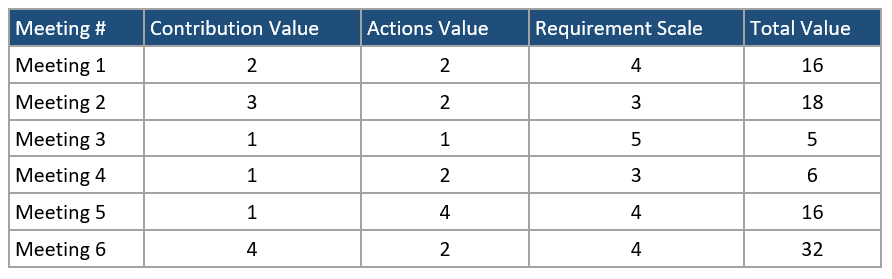
You are looking for two key numbers. The first is key meetings with low action value (column 3). It is not a rule but generally, if you can walk out of a meeting with no new action items, it is very likely that you could receive the information in a different format than a meeting. The other key number is the high requirement or expectation scale with a low value. Take Meeting 3 for example. You provide a little contribution. You receive no new action items. And you are expected to be there every time. Your attendance at this meeting needs to be evaluated.

2. What Value Do I Bring to the Table?

Depending on your position in your organization, you may or may not have the freedom to click the “Decline” button on calendar requests.  But the least you can do is have an internal conversation and estimate what value proposition you provide by sitting at the table.  Is it a hard value or a perceived value?  A hard value is one in which you regularly contribute verbally or provide inputs that add to the meeting purpose.  Perceived value is where you are deemed important by your colleagues and they feel like you just need to be there.  If your attendance is required make sure you bring value to the meeting.  There is no better testimony to your lack of value proposition than rarely contributing anything to meetings or rarely receiving action items as a result.  The key is to find out what matters to your manager or the meeting facilitator.

Review the minutes of your most recent meetings attended and look for the value you have added or the actions you have received.  If neither exists then consider a discussion with your manager or the meeting facilitator about being more selective about your required attendance.

3. Are My Previous Action Items Completed & Communicated?

Let’s clear the confusion right away. Action items are performance expectations. Get them done by the target established in the meeting and communicate to the team that they are completed. So much time is wasted reviewing incomplete action items.

If, by chance, you are unable to complete action items assigned to you communicate that to the team prior to the meeting. But don’t just say “I didn’t get this done.” Include an updated plan and the expected completion date for the team. This will help your section of the meeting proceed without interruption.

4. Am I Prepared?

I am going to use the phrase “this was funny” but it is anything but funny. I was prepping for a meeting and needed to print out some data packets to share during my portion. There was no reason to believe that anything would be different this time.

I pushed “Print” just before leaving my office with my laptop in hand. When I went to the printer there was an error message. Now I am panicking. I knew I should have given myself more time to prepare just in case something like this happened. In fact, I had considered printing and preparing the day before just to be sure. Murphy’s Law bit me hard. Lesson learned.

Prepare early and give yourself enough time in case the unfortunate circumstance delays getting all you need for the meeting.

5. Have I reviewed the agenda? Be prepared to add value to the issue.

Having an agenda before a meeting was discussed in Part I – a previous post. Here we will assume that the meeting organizer is following best practices by publishing an agenda ahead of time.

Reviewing the agenda helps you gather data prior to the meeting so that if or when you are called on for some input you will have the data to back up what you say. Another benefit is that a review of the agenda will help you frame your participation knowing when you can stay silent and avoid non-value added inputs to the conversations.

6. Do I have any related issues that were not on the published agenda?

This situation usually happens with recurring meetings. You have an issue that needs to be addressed. You submit it to the organizer. Then you see that it is not included on the agenda. Better to ask the organizer to include the issue prior to the meeting and receive feedback on why it will not make the agenda than to risk the awkwardness during the meeting.

7. Do I have the bandwidth to accept action items?

Have you been here as well? Your schedule is already overloaded. You barely had time to make this meeting. By then end, you have been assigned a couple of tasks with no capacity in your schedule to add any more.

One thing to consider is whether you can realistically contribute to the execution of the meeting team’s actions list. If you barely have time to attend, how will you have time to add more actions? Take this into consideration as you evaluate whether you should or should not attend a particular meeting.

Summary

Answering these critical 7 Questions will enable you to increase your meeting effectiveness, increase the value proposition, and reduce the time you spend on non-value activities. The 7 Questions reframed as 7 Best Practices for Meetings are:

  • Do I Need to Be There
  • Can I Add Value
  • Are My Actions Completed
  • Am I Prepared
  • Have I Reviewed the Agenda
  • Do I Have Other Issues Not On the Agenda
  • Can I Realistically Accept Action Items

Resources

  • Dieken, C. (n.d.). Talk Less, Say More: Three Habits to Influence Others and Make things Happen: Kindle Edition. Wiley
  • Elliot, B. (n.d.). MAKE YOUR POINT!: SPEAK CLEARLY AND CONCISELY ANYPLACE, ANYTIME: Kindle Edition. AuthorHouse
  • Granville, T. (n.d.). The New Articulate Executive: Look, Act and Sound Like a Leader: Kindle Edition. McGraw-Hill Education
  • Lencioni, P. (n.d.). Overcoming the Five Dysfunctions of a Team: A Field Guide for Leaders, Managers, and Facilitators (J-B Lencioni Series): Kindle Edition. Wiley
  • Wortmann, J. (n.d.). Mastering Communication at Work: How to Lead, Manage, and Influence. Kindle Edition. McGraw-Hill Education
DMS 2.0 – Process Flow

Your data displayed is either visible or visual. If the data is displayed and your business is “business as usual” then your data is visible – not visual. If it triggers actions based on gap identification resulting in an improved process then it is visual.

Visual Verses Visible

The first step is for data to be made “Visual.” I use the word “visual” with intention as opposed to being visible. Being “visible” just means that the information can be seen. When data is “visual” it has meaning. It can be understood quickly and easily. Interpreting the data is not ambiguous because it is designed to display in a binary format – “Did we hit the target as planned?”

A way to tell if your data in your visual management system is just visible or qualifies as visual is to review it on a regular cadence such as a Gemba walk. If you see that the chart or graph is not updated regularly or if few people who use the board know when and what to do if a trigger condition happens you have a visible display, i.e. fancy wallpaper.

Visual Management as Process

Visual Management – like the other three elements is a process

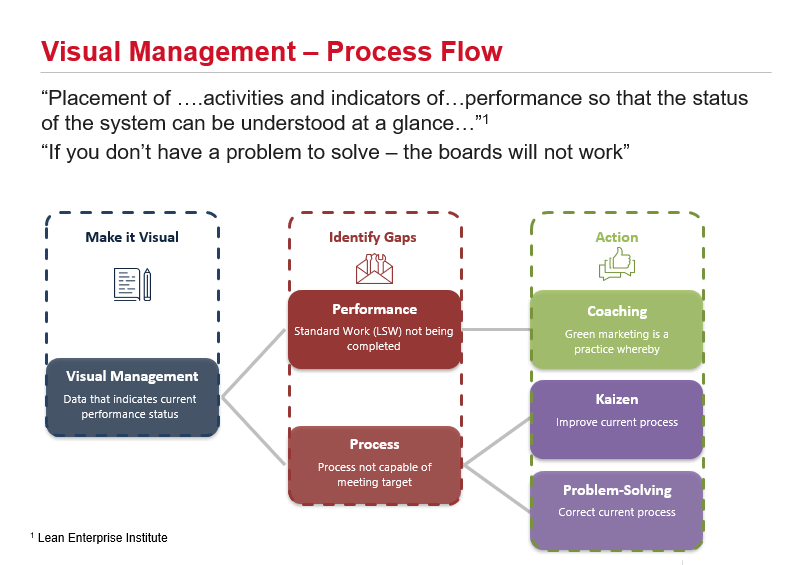
  1. Step one is to use “meaningful data” that accurately reflects the current state of our performance and makes it quick and easy to see and understand the “Actual” verses “Planned” or “Target” state.
  2. Since we are focusing on “process” and not “people,” our gaps fall into either of two categories:
    • Performance Gap – Was the process followed? Was standard work or Leader Standard Work completed as designed?
    • Process Gap – Standard Work / Leader Standard Work is designed to produce expected results. If Standard Work is performed as designed and a gap exists, that reveals that the process is not capable as designed so we need to correct or improve the process (the way we do the work).
  3. Step three is to take the appropriate action
    • For performance gaps – coaching or accountability systems are used to improve adherence to standard work.
    • Process gaps result in either improvement (Kaizen) or problem-solving to make the process capable of meeting the target condition.

Summary

Your data displayed is either visible or visual. If it triggers actions based on gap identification resulting in an improved process then it is visual.

If the data is displayed and your business is “business as usual” then your data is visible.

Both may look good. Only one will work to drive the improvements you are hoping to make with your visual management system.

I would love you hear your thoughts on this. Leave a comment or send an email.

-Rich

Leader Standard Work – PDCA

The art of using LSW as an improvement tool is to be able to read the sheet with your “process” eyes. What this means is not to focus on reds and ask “why didn’t they get done?” What you are looking for as a lean leader are process gaps.

Updating my LSW – reviewing November for lessons learned and applying PDCA to December’s LSW plan

Download a copy of the Excel template used in this post by clicking the link below

Introduction

Leader Standard Work is a leaders visual management system much like a DMS board, Kamishibai, or other lean visual control. The intent is to regularly review (monthly in my case) for opportunities for process improvements (reds) and apply those improvements to the next cycle. Visual Leader Standard Work will reveal two types of gaps: performance and process.

Performance gaps are simple – “was the task completed?” Performance gaps require deeper learning and analysis. In this post it will be assumed that there are no performance gaps to address – only process gaps.

The Review

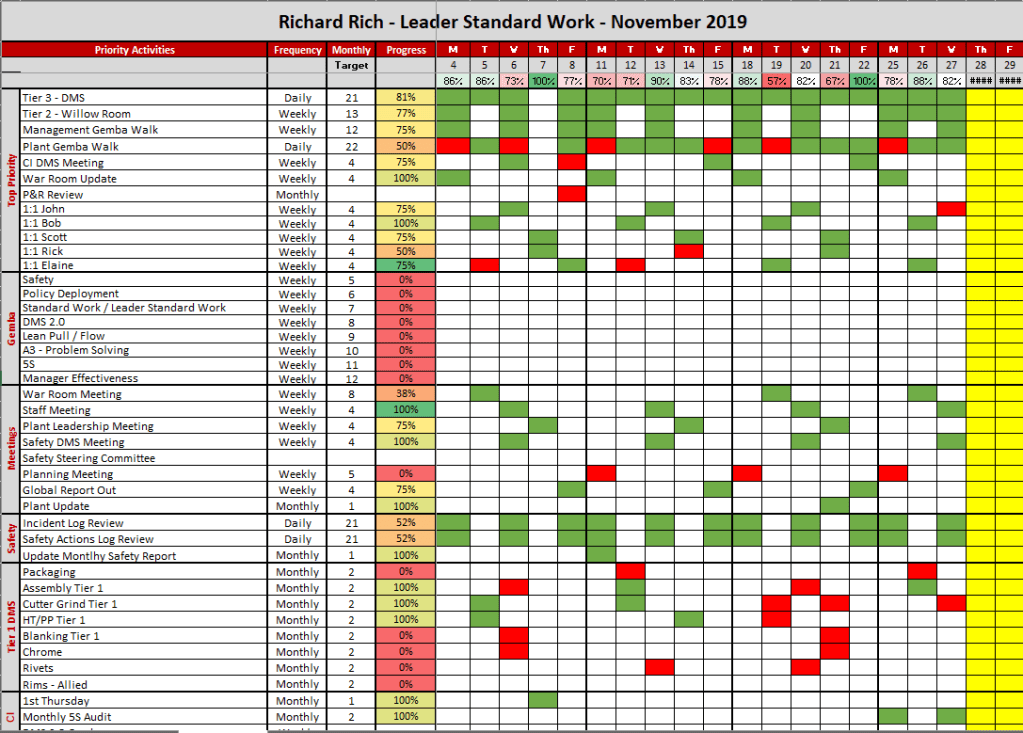
The image below is of my LSW for November.

The art of using LSW as an improvement tool is to be able to read the sheet with your “process” eyes. What this means is not to focus on reds and ask “why didn’t they get done?” What you are looking for as a lean leader are process gaps.

Each behavior or activity of a leader in a lean management system is to sustain process improvements where that same process stability will provide the foundation for further improvements. The focus is on process.

Assuming that there are no performance gaps (the activity was completed as planned) we can move to what constitutes process gaps. Reds will indicate one of two possibilities.

  1. The behavior or activity (audit, Gemba, etc.) is not able to sustain the process. You are unable to really “see” the process in order to measure the expected state verses the current state.
  2. The process is not adequate to sustain the improvement. In this case a red means that you are able to clearly see the expected state and current state but something is not working right – there is a gap, a problem, or a variation.

Lessons Learned

After review it is time to see what you can learn about the process. Analyze the patterns.

In the example above I saw groupings around a particular time of day for attending Tier 1 DMS meetings. The conflict that created the reds were clear and recorded on the paper version that I carry daily. Each one that is missed was due to overlapping requirements at other DMS meetings. It had nothing to do with performance and everything to do with the fact that one cannot be in two places at the same time.

Planned Improvements

The lessons learned from reviewing November’s LSW were used to create December’s.

  1. Space for attendance at the conflicting Tier 1 DMS meetings was created
  2. Communication for Tier 3 DMS attendance plan was provided and aligned to with my manager
  3. Activities planned for early mornings where Tier 1 DMS meetings happen are now planned for later in the day.

Summary

It’s December 1st. Tomorrow is Monday, December 2nd. Is your LSW reviewed and updated? Have you made a plan to sustain the lean improvements?

Take a few moments and reflect on what learned from last month adn make an improvement to be a better lean manager for December

Stakeholder Analysis

There is no way to guarantee your change proposal won’t result in anyone reacting negatively. Change is hard. There is hope though. Use this tool to mitigate the chances of missing someone

Have you been there? You put together a great plan, communicated to the leadership team and got their buy-in. Then, just when you think you are in for some smooth sailing, a person speaks up about how they feel left out. I remember being in a progress update meeting for a new initiative that, to my knowledge, was going pretty well. The person was expressing feelings of hurt and anger that they had not been consulted or even informed of the impact the changes were making. So much so that they didn’t feel they could support the changes.

What had gone wrong? Where did the project manager miss?

We met for a debrief and reviewed the project notes. Low and behold they had missed a very important facet of managing change…

The Stakeholder Analysis

They did a great job following Kotter’s model by building a “guiding coalition” but had missed this critical step. It is here that the brakes of change are often pressed and the initiative comes to a screeching halt.

Here is what I have learned and applied with the stakeholder analysis. Nothing is guaranteed but getting a grip on this step will help ensure your initiative can proceed through each milestone unimpeded by the “forgotten ones.”

Download a free copy of the Stakeholder Analysis Template and a sample file


Stakeholder List

List all of the people impacted by the change. Use positions or titles and not names. Don’t worry about their specific roles. Your focus is just to get them on the paper. It is better to have more people and pare it back after the next step.

Impact / Influence Analysis

Here is where you will determine which approach or tactic will be used to keep the list of people in the loop. It is the Impact/Influence Analysis tool. It is very simple.

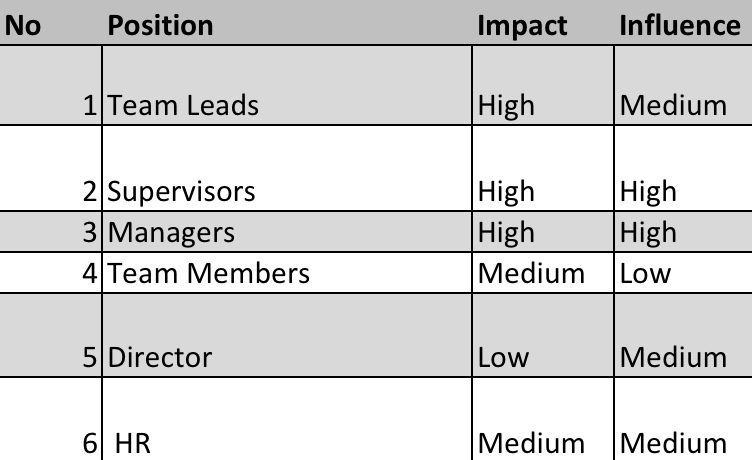
Impact / Influence Matrix

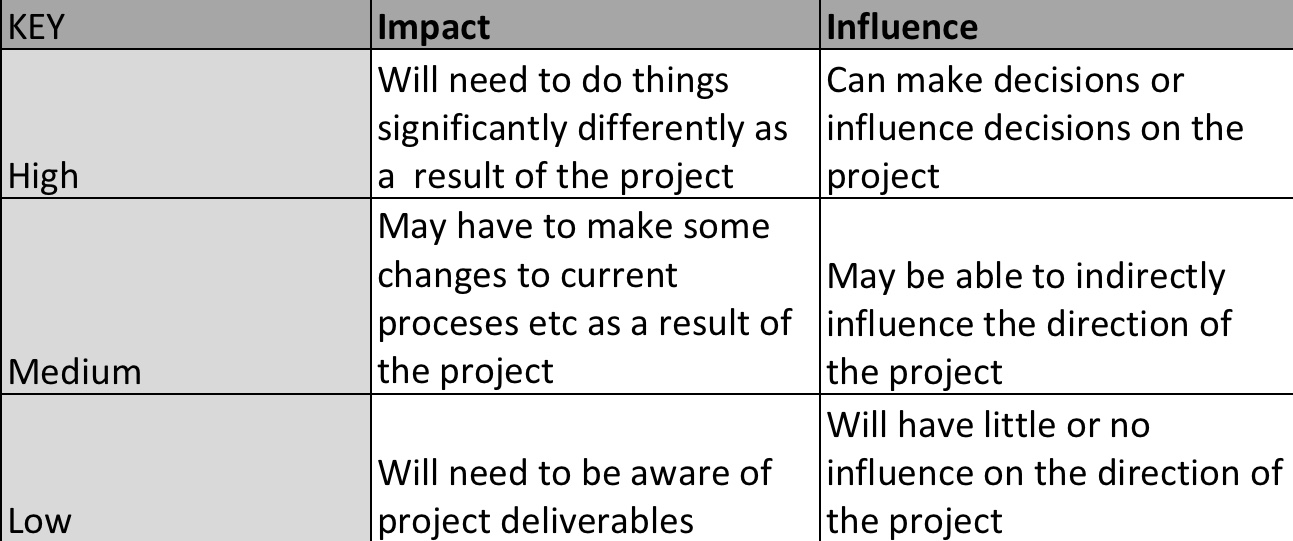
For each person on the list you will select (for Impact) do they have High, Medium, or Low impact to the initiative based on the criteria in the description. Then in the next column select (for Influence) whether they have High, Medium, or Low influence on the initiative.

The value is not being precise with the measurement but to take each possible stakeholder into consideration to make sure they don’t get left out of the communication plan.

Now work your way across the sheet from left to right:

  • List the key concerns of each stakeholder
  • Evaluate their current engagement level
  • Establish their target engagement level
  • Develop an engagement tactic to close the gap between current and target engagement
  • Lastly, determine who, on your change team, is going to own managing the stakeholder to ensure the gap is closed

Summary

There is no way to guarantee your change proposal won’t result in anyone reacting negatively. Change is hard. There is hope though. Use this tool to mitigate the chances of missing someone. It is just a matter of due diligence. The work put into this step will pay dividends through the rest of the implementations as precious resources won’t need to be allocated to fighting culture fires that could’ve been prevented.

What are your thoughts? I’d love to hear about how you have engaged people in your change process and what you learned. Please feel free to comment below or drop me an email!

Can Your Team Handle the Change?

Can Your Team Handle the Change?
The next step in managing change is to assess how ready your team or organization is able to deal with the changes you are proposing.

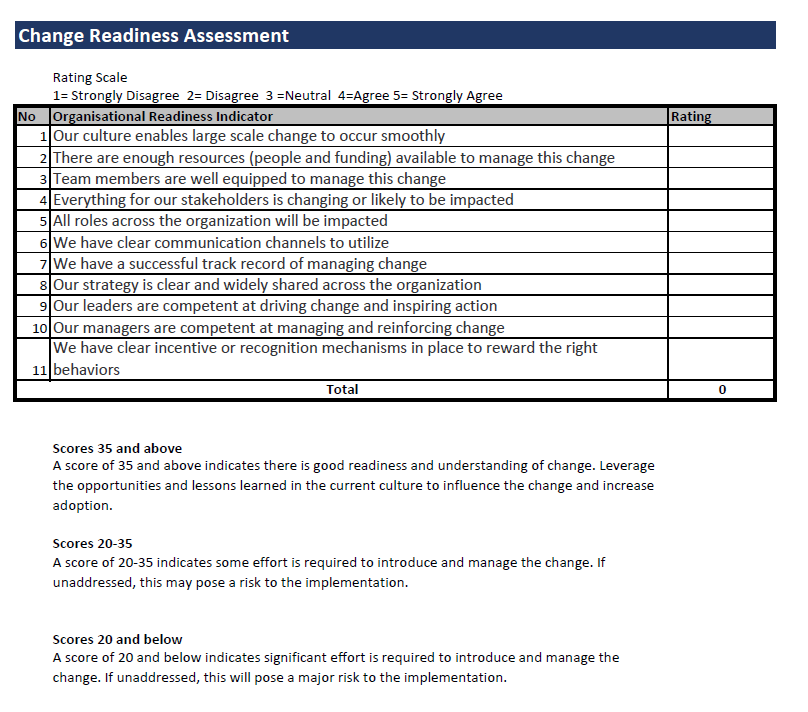
The Change Readiness Assessment

The next step in managing change is to assess how ready your team or organization is able to deal with the changes you are proposing. Don’t skip this step. Many change efforts fail not because they were not good projects or even critical to business sustainability but simply because the culture was not ready for the change. Subsequently, the tools available to manage change were not used and the culture became overwhelmed.

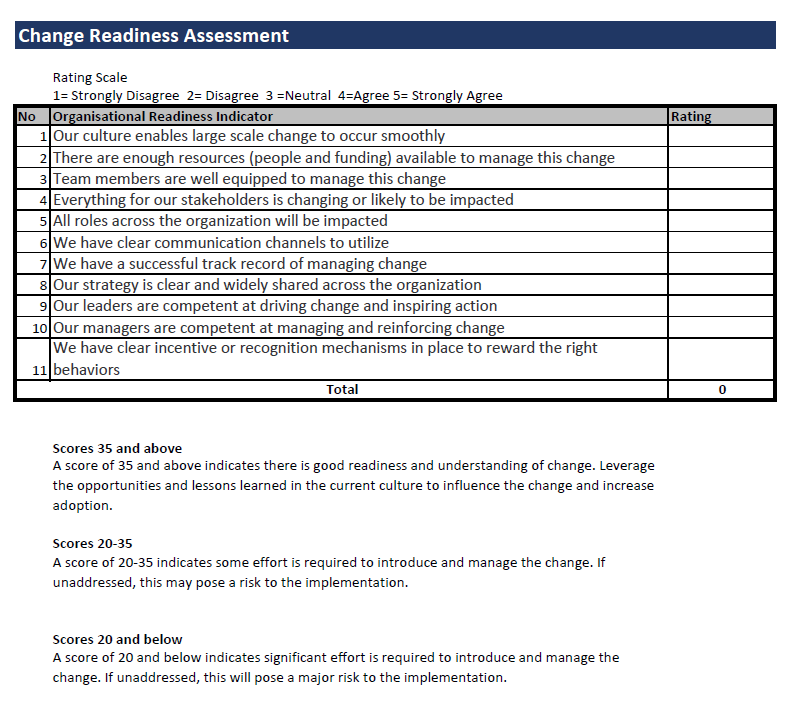
It is a simple yet crucial process. Just score the following questions using a 1-5 linear scale

1= Strongly Disagree 2= Disagree 3 =Neutral 4=Agree 5= Strongly Agree

1Our culture enables large scale change to occur smoothly 
2There are enough resources (people and funding) available to manage this change 
3Team members are well equipped to manage this change  
4Everything for our stakeholders is changing or likely to be impacted  
5All roles across the organization will be impacted 
6We have clear communication channels to utilize
7We have a successful track record of managing change 
8Our strategy is clear and widely shared across the organization 
9Our leaders are competent at driving change and inspiring action 
10Our managers are competent at managing and reinforcing change 
11We have clear incentive or recognition mechanisms in place to reward the right behaviors 


The total score at the bottom of the assessment is the “readiness” or your team to embrace the changes you are proposing.

Scores 35 and above
A score of 35 and above indicates there is good readiness and understanding of change. Your change toolkit will require fewer inputs to manage the initiative. Look back at successful implementations and the lessons learned to increase the adoption rate of the change.
Scores 20-35
A score of 20-35 indicates some effort will be required to introduce and manage the change. There are risks that need to be addressed and mitigated to make the implementation successful.
Scores 20 and below
A score of 20 and below indicates significant effort will be required to introduce and manage the change. A large focus on the change management implementation plan will be around risk and risk management.

Summary

Are you planning to kick off a change proposal to your leadership team? Or are you in the planning phase of a significant implementation? Take a moment and run through this readiness assessment with your charter team and get a good view of the work necessary to manage the change based on your team’s ability to assimilate the changes.

As always, I’d love to hear back about your experience with both challenging and successful change initiatives. Feel free to drop me an email or comment below.

The Change Management Charter

suggests, the starting point of any effective change effort is a clearly defined business problem. By helping people develop a shared diagnosis of what is wrong in an organization and what can and must be improved, a general manager mobilizes the initial commitment that is necessary to begin the change process

…the starting point of any effective change effort is a clearly defined business problem. By helping people develop a shared diagnosis of what is wrong in an organization and what can and must be improved, a general manager mobilizes the initial commitment that is necessary to begin the change process.

Harvard Business Review. HBR’s 10 Must Reads on Change Management (including featured article ‘Leading Change,‘ by John P. Kotter) . Perseus Books Group. Kindle Edition.

The Change Management Charter

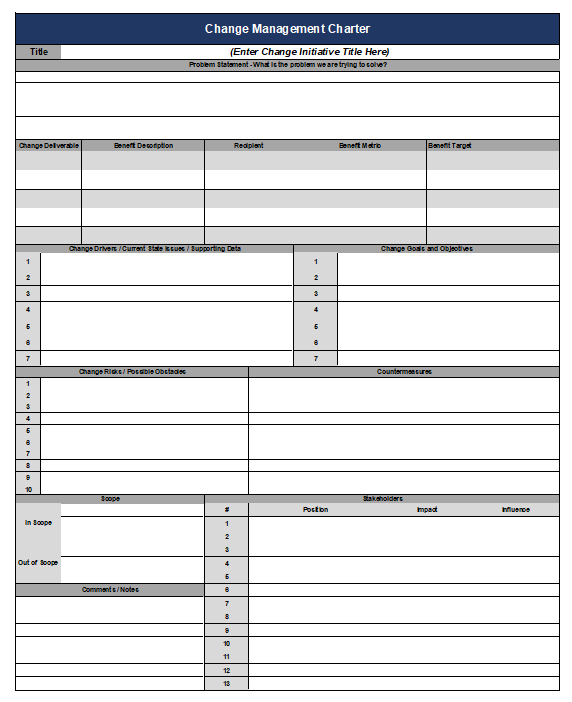
The most important and most overlooked part of planning any change initiative is the charter. Get at least this section of the change methodology correct and you are most of the way to a successful and less painful change project. A well-designed change management methodology will consist of at least these seven items – the last one, an after-action review, is not on the charter but is part of the collection of tools:

  • Problem Statement
  • Deliverables
  • Change Drivers
  • Change Risks / Countermeasures
  • Scope Parameters
  • Stakeholders


Get the charter right and the rest of the plan will come together. This is because the charter, when completed, is a reflection and evidence of a deep dive to grasp the current condition, understand the risks both operationally and culturally, and consideration of the human element in change management.

The Problem Statement

This is the hardest part of any change – to define the problem and communicate it in a way that will ensure buy-in and alignment from upper management, peers, and team members. In fact, most change initiatives fail at this step. This is where most of the work should take place. The information gathered and entered into the charter will feed into the rest of the key tools of your change management methodology.

Take the time, put in the work, and use data – good data. One thing that helps is to use specifics. Similar to describing a target with S.M.A.R.T. goal discipline, use the 5W’s and 1 H to write out the problem – Who, What, Why, Where, When, and How. A well researched and data-supported problem statement will get your audience into solution-finding before they are even aware that they have gone there.

Deliverables

So let us assume that your problem statement is solid. There is agreement on the problem and everyone wants to move forward. The question now is what or how will your idea fix the problem?

Here is where you want to define four elements that will be delivered through the change initiative

  • Benefit Description – what will the benefit be – how is it linked to the problem?
  • Recipient – who will be impacted by the benefit?
  • Metric – how will the benefit be measured to validate the proposals?
  • Target – after we agree on a way to validate the improvements what defines success? What will the target of the benefit be?

Change Drivers / Current State Issues – Change Goals & Objectives

These two sections describe the current state of the process that needs to be changed and the corresponding target state or “objective.” Using the word “driver” denotes the specific actions taking place that are causing the unwanted condition to exist. It is important that a goal or objective is directly linked to a driver or a specific issue. This will ensure that all the necessary issues have been discovered and a plan exists to correct or improve them.

Change Risks / Countermeasures

All change carries risks, operationally and culturally. This is where you make sure that proper risk analysis has been completed with countermeasures to address each one. This step, after the problem statement, is the most often missed and the one where the consequence is the greatest. Every risk with associated stakeholders needs to be addressed. Along with that is the risk of doing nothing.

There are plenty of sources available for performing risk analysis. Whichever is chosen, make sure you dive deep and select countermeasures to mitigate the risk to acceptable levels.

Scope Parameters

This often missed step is the silent killer. It seems unnecessary until the work sessions begin to take place. As you recruit your multi-disciplinary teams to work on the solutions the participants usually begin adding solutions to address all the problems. You will hear statements like “well, the question then becomes….” or “if we going to (insert solution here), we might as well do this (insert another idea) while we are here.”

If you are looking to extend the completion date of your initiative, this is the way to do it. Allow add-ons to the list and you will never get done.

Define the parameters to your change initiative and stick to them. You will often refer to them as your team works its way through the change process. Define what is in-scope and what is out-of-scope.

Stakeholders

Have you ever arrived at your roll-out date, training event, or kick-off only to hear feedback from people that they are unaware of the change and don’t understand why it is happening? That is a good indication that a proper stakeholder analysis was not completed (as well as a communication plan but that will be covered in a later post).

In this crucial step, you will list the people affected by the proposed change. Similar to a RACI chart, this will help to develop a communication plan to eliminate or at least reduce the shock or impact the change will have on the people in your organization.

If you haven’t yet downloaded a PDF of a template you can do so here. In it, you will see that when you are listing the stakeholders, you will also try to estimate the impact and influence they will have on the success of the change. Those with high influence will need to be approached differently than those with low influence. They will need to be on board. This is the group mentioned by John Kotter as the “guiding coalition.” Those who measure high on the impact scale will need more attention to the “why” behind the change and the “how” of the level of disruption it may cause.

Summary

Have you been tasked with making an organizational or team change? Let this charter be your first step to successful change implementation.

I’d love to hear back about your experience with both challenging and successful change initiatives. Feel free to drop me an email or comment below.

Leading Change in a Company That’s Historically Bad At It

The more people that are involved, the greater the need for a plan for change management.  The article notes these three keys for turning the tide on leading change:

The details in this article resonate well with my career, especially the early part.  The paradox of being good at problem-solving and providing solutions was lived out daily.  You have a history of solving problems so naturally you are given larger problems with more complexitywith greater impact to more people.  As you drive the solutions you quickly find out that change is easier when you are an individual contributor.  The more people that are involved, the greater the need for a plan for change management.  The article notes these three keys for turning the tide on leading change:

  1. First, acknowledge past failures.
  2. Ground your plan in evidence. 
  3. Regularly ask how your plan for change feels different from past efforts.

I would like to offer some insight into the second key on grounding your plan in evidence.

The methodology and tools / resources are not mine.  I adopted them and use them regularly combining them with other lean tools like A3’s.  It is the frustration and failures of past change attempts that keeps me tied to the list of change management tools that follows.  They will be upacked individually insubsequent posts but are listed here as a foundation for developing your own rigorous change management plan.  When these were adopted and practiced with discipline I found them to be a change enabler that shortened the adoption time of the proposals and also lessened the resistance and eased the emotional cycle that stakeholders experience when going through change.

My change notebook – my “plan in evidence” consists of:

  1. Change Management Charter
  2. Change Readiness Assessment
  3. Stakeholder Analysis
  4. RACI Matrix
  5. Communication Plan
  6. Risk Management Assessment
  7. Risk Management Plan
  8. Impact/Effort Wins Matrix
  9. Change Implementation Plan with milestones
  10. After Action Review

More to come on the use of these tools so stay posted.

I’d love to hear what you have experienced and learned through your challenges to implement change in your organization.  Feel free to leave a comment or send an email.

Source: Leading Change in a Company That’s Historically Bad At It

Four Tips for Personal Journaling

We are going to help you be able to sit down and begin a journal that will be yours.  It will fit with the way your mind works.  It will fit your creative style.  In essence – it will be a reflection of who you are! 

Congratulations. You are joining an elite group of people who recognize the importance and value of keeping a personal journal. I have found this to be one of my core personal habits. It is the one thing that keeps me centered psychologically, emotionally, and spiritually. I have found a freedom to express thoughts and feelings that prior to having a journal, I would never entertain thinking about.

My journal is my safe place. There is no judgment in its pages. Just freedom to be me, to express, and to be transparent and vulnerable. It is in this habit of freeing my mind to be open and honest that I have discovered the real person hiding deep down inside.

I hope to help you in your journey and to shorten the time between the choice to pursue the habit of writing and the realization of the value and benefits of the practice. What follows are four tips or words of advice to do just that. I welcome you to this side of the universe! Welcome to the world of journaling.

Tip 1 – Have a Purpose for Your Journal

The first bit of advice is to define your purpose. Why do you want to journal? What was happening at the exact time that made you think “I’d like to begin the habit of journaling?”

There are many possible reasons but they usually center around a few:

  • Capture life moments to share with your family later
  • Personal development
  • Creative outlet
  • Emotional expression
  • Personal healing
  • Professional effectiveness

The benefits of the habit of daily writing and reflection are well known. In fact, one piece of data I recently came across noted that people who journal (write their goals down) are 95% more likely to accomplish them.

The missing piece, however, is the challenge like any new thing that we start, is to stick with it once you’ve started. We will walk through some other tips in this blog the the first and beginning tip is to be clear on your purpose. Know why you want to begin the habit of regular journaling.

Tip 2 – Realize a Value From Journaling

Like anything else, it will be new. This tip is especially important if keeping a journal is something you have always wanted to do and told yourself you would. In fact, it is probable that you may have already tried and started to journal but gave up the habit shortly into the pages. That is okay. I did the same thing.

Unless you receive some type of satisfaction or intangible value from the time and creative energy you put into regular writing, it becomes a chore. No one likes chores – especially me. If, however, you find a value that is greater than the effort, the process of journaling becomes less dependent on rigor and grit and ends up being enjoyable. Avoid the feeling that it is just a regimen at all costs. Every time you start and stop something it becomes harder to start over again. This is because our brains will bring up the memory of our past failed attempts. The negative self-talk may be more than enough to discourage you from doing the one thing to get you out of your rut and take you to the next level.

Tip 1 informed us that we have to know why we are journaling – what do we want out of it. Now we need to get the value out of what we wanted. So in this step, we are going to define the value. It is very simple. Complete the phrase “Journaling will be good for me because _______________.” This is how you will measure value. This will result in the pleasure principle in your mind that will actually release chemicals in your system that tell you “This feels good.” You will experience an increase in the desire not only to journal more frequently but to increase the breadth of content that you are writing about.

Remember this key tip – Your Journaling Has to Add Value.

Tip 3 – Fit Journaling With Your Creative Style.

I am currently on my 6th completed journal (book). Several before them were started but never finished. They included pages with dates or calendars preprinted on them, daily planner items, specific productivity formats, and other help by various publishers. They ranged from the more professional/executive style to the student/homework planning style. They are all good and I don’t mean to downplay the effectiveness of the content, format, or creative genius of the authors.

I found that preset formats were very limiting for my creative mind. This was learned over time. The reason I chose the formatted styles was being a novice, I had no idea what to write. I would sit down, open the cover to the next page and – BLANK! I didn’t know what to say. It was funny because It felt like there were so many thoughts rolling around in my head that they could barely be kept together but when it came time to write there was nothing coming out of my pen.

I hate the feeling of failure or ineffectiveness.  Approaching the journaling process with a preset format was the crutch to get me over the hump.  I would fill in the blanks as best I could by checking off the boxes that the publishing company thought would work for me but at the end of the day, it still didn’t click.  It was like I was filling out someone else’s journal.  It became cumbersome and a chore like we talked about in Tip 2.  Since I didn’t know what to write or how to write it I depended on someone else’s style to dictate how my thoughts would be captured in my journal.

Fortunately, you will not have to experience this. We are going to help you be able to sit down and begin a journal that will be yours. It will fit with the way your mind works. It will fit your creative style. In essence – it will be a reflection of who you are!

For now, avoid journals with formatted pages or content. We need to discover how our minds operate and express thoughts and ideas. You will see that as you free yourself up and let your mind go while holding your pencil or pen, the pages will fill easily as the creative flow is unleashed on blank pages.

The best way to begin is to sit and just record the day and time. Write it down. Next, briefly describe how you feel right now. Don’t mince words. Just be open and honest. Are you tired? Are you frustrated about life or work? Are you experiencing anxiety about your relationships. No need to qualify. Just write it down. Don’t worry if your words are many or few. It doesn’t matter. More words will come as your mind gets used to the newfound freedom.

Next, briefly describe what your day looks like. What is your biggest challenge today? How are you or how will you be prepared to handle it? Write it down.

Lastly, write down a phrase of affirmation. Something that you would say to a friend if they were walking in your shoes right now. Encourage that person. Later on in the evening, you will return to your journal to reflect on the day and receive the words of encouragement.

Tip 4 – Create a Journaling Habit

To get the most value of your personal journal it must become a regular practice. Developing a routine of journaling will, at first, seem like registering for a gym membership right after New Year’s Day. We have already covered the first three elements to take the chore-like feeling out of journaling. Since you will have a purpose (Tip – 1), it will be adding value (Tip – 2), and it will be a reflection of who you are as a person (Tip – 3), The final key is to commit to the routine of journaling. Having covered the first three steps, the time required for the adoption of journaling from a routine to a habit where your mind goes into automatic “journal mode” will be shortened significantly. You will find the time very satisfying and invigorating to the point that you will begin carving out and protecting that time; prioritizing it over old habits that are actually destructive to your personal development. I don’t like coaching people to “develop a habit of …” because habits are a result. If it were that easy to “develop a habit” everyone would be accomplishing everything they started. The process of developing a habit is not easy but it is simple.   The key is repetition.  Just do it. 

A few answers to these questions will help you decide when and where to write in your journal: What is your best time of the day – when are you the most attentive and creative? Do it then. Try the early morning before anyone else is up. If that doesn’t work then try another time. Keep trying until it clicks.

Summary

It seems hard. You don’t know what to write. That’s okay. Everyone starts that way. Just go buy a nice journal. Keep it private. Sit down and write. Use the tips above and see if shortly you come to really enjoy your time and can’t understand why other people don’t journal themselves.

I’d love some feedback on this. What have been your challenges or what have you been experience while you journal?